
 Mobile App Development
 Software Development
 AI Solutions & Automation
 IoT Solutions
 Web Development
 Cyber Security
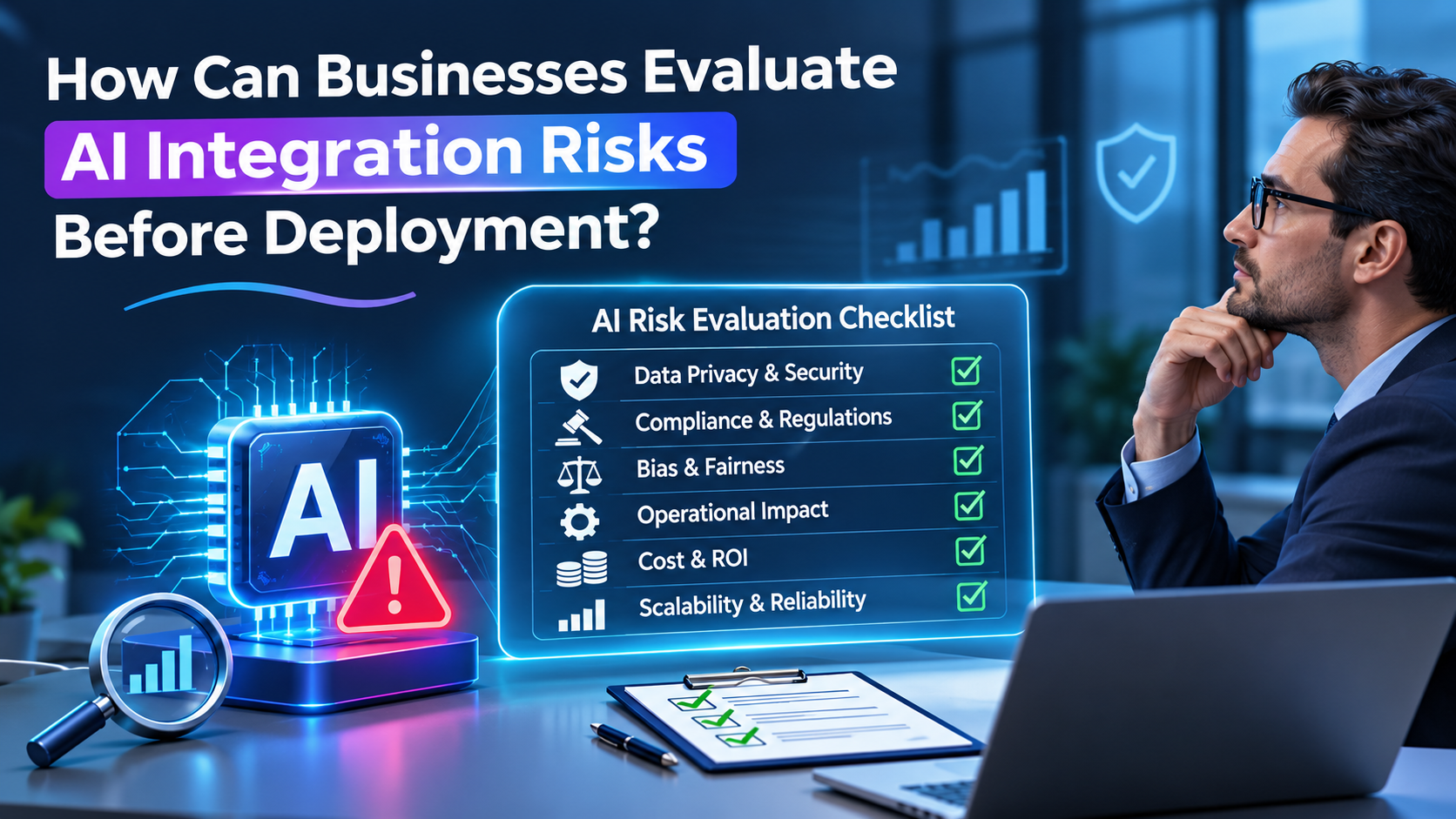
How Can Businesses Evaluate AI Integration Risks Before Deployment?

Supportsoft Nov 20, 2026
Artificial intelligence is being incorporated into business applications to support data analysis, automate workflows and improve decision-making. However, introducing AI into existing business operations requires careful consideration of data privacy, cybersecurity, system reliability and operational risks. Businesses should evaluate these factors before deployment to ensure AI applications operate safely, meet business requirements and integrate appropriately with existing processes.
Introduction
Artificial intelligence can help businesses automate repetitive tasks, analyse information, improve customer interactions and support operational decision. However, introducing AI into business operations also creates risks that organisations need to understand before deployment.
An AI system may process confidential business information, interact with existing applications, generate recommendations or influence decisions that affect customers and employees. If these systems are not properly assessed, businesses may encounter data privacy issues, security vulnerabilities, inaccurate outputs, unexpected operational problems and compliance concerns.
Evaluating AI integration risks before deployment helps businesses understand where these problems could occur and what controls are needed to manage them.
This article explains the main risks businesses should consider, how to assess their potential impact and which safeguards can support a more reliable AI implementation.
Why Should Businesses Assess AI Integration Risks?
AI systems behave differently from conventional software. Traditional applications generally follow predefined instructions, whereas AI models generate outputs based on patterns learned from data and the context in which they operate.
This can make their behaviour less predictable, particularly when they encounter unfamiliar inputs, incomplete information or situations outside their intended use.
For example, a business might introduce an AI-powered customer support system to classify enquiries and suggest responses. If the system misunderstands a customer’s request, it could provide incorrect information or direct the enquiry to the wrong department.
Similarly, an AI application connected to internal business records could expose confidential information if access permissions and data handling rules are not properly configured.
A risk assessment helps businesses:
- Identify potential problems before they affect business operations
- Understand what information an AI system can access
- Evaluate whether generated outputs are sufficiently reliable
- Establish appropriate security and privacy controls
- Determine where human review is necessary
- Prepare procedures for responding to system failures
- Monitor performance after deployment
Risk assessment should be treated as an ongoing activity rather than a one-time approval step.
Identify the Main AI Integration Risks
Before introducing AI capability into business software, organisations should identify the risks associated with its intended purpose, data access, users and operating environment.
The following areas deserve particular attention.
Data Privacy and Confidentiality Risks
AI applications may process customer records, employee information, financial details, business documents and other sensitive data.
When this information is submitted to an AI model or third-party service, businesses need to understand how it is collected, processed, stored and potentially reused.
For example, an employee might enter customer information into an AI-powered tool to generate a response. If the tool's data handling arrangements are unclear, confidential information could be exposed or retained in ways the organisation did not anticipate.
Businesses should evaluate:
- What personal or confidential information the AI system requires
- Whether the information is necessary for its intended function
- Where data is processed and stored
- Whether the provider uses submitted information for model training
- How long information is retained
- Whether data can be deleted when required
- Who can access the information
Businesses should also consider applicable privacy obligations and establish appropriate policies for handling personal and confidential information.
Cybersecurity and Unauthorised Access
Connecting AI applications to business software can introduce additional security considerations.
An AI system may require access to databases, internal APIs, document repositories or customer management platforms. If permissions are too broad, a compromised account or poorly controlled integration could expose information beyond what the application needs.
AI-specific threats can also include prompt injection, malicious inputs, insecure model interfaces and vulnerabilities involving third-party services.
For example, an AI assistant connected to an internal document repository might retrieve information that a particular user should not be authorised to see. Without appropriate permission checks, the system could expose confidential documents through generated responses.
Businesses should assess:
- Authentication and authorisation mechanisms
- API security and access permissions
- Encryption of data in transit and at rest
- Protection of model endpoints
- Third-party provider security practices
- Logging and monitoring arrangements
- Procedures for identifying and responding to suspicious activity
Inaccurate or Unreliable AI Outputs
One of the most important AI integration risks is the possibility of incorrect or misleading outputs.
Generative AI systems can produce responses that appear convincing but contain inaccurate information. Predictive models can also generate unreliable results when the input data is incomplete, outdated or different from the data used during development.
Consider an AI application that summarises financial information for management. If it misinterprets a figure or omits an important qualification, employees could make decisions based on an inaccurate summary.
The consequences depend on the business use case.
An incorrect product recommendation may create a customer experience problem, while an inaccurate output used in financial, legal or operational decisions could have more serious consequences.
To evaluate reliability, businesses should:
- Test the system using representative business data
- Check outputs against verified information
- Identify situations where the model performs poorly
- Establish acceptable accuracy thresholds
- Test unusual and incomplete inputs
- Require verification for important outputs
- Provide a way to report incorrect responses
The level of accuracy required should reflect the consequences of an incorrect result.
Bias and Unfair Outcomes
AI models can reproduce or amplify patterns present in their training data.
If historical information contains incomplete representation or unfair patterns, an AI system may produce outcomes that disadvantage certain individuals or groups.
For example, an AI application used to screen job applications could favour particular employment histories if its underlying data reflects biassed recruitment practices.
Businesses should consider:
- Whether training and evaluation data is representative
- Whether certain user groups receive consistently different outcomes
- Whether the model uses inappropriate variables
- Whether its decisions can be reviewed
- Whether affected individuals have an appropriate way to raise concerns
Bias testing should be relevant to the intended application. A system used for low-impact content recommendations may require different assessment measures from one influencing recruitment, lending or access to important services.
Integration and Operational Risks
AI systems rarely operate independently in a business environment. They may exchange information with existing applications, databases and workflows.
This creates operational risks if the AI component does not interact correctly with the surrounding software.
For instance, an AI-powered inventory forecasting tool might generate recommendations using outdated stock information. If those recommendations are automatically passed into an ordering workflow, the business could place unnecessary orders.
Potential operational issues include:
- Incompatible data formats
- Delayed or failed API requests
- Incorrect information synchronisation
- Unexpected changes to existing workflows
- Increased system response times
- Dependency on external AI services
- Limited fallback options when the model becomes unavailable
Businesses should map the systems involved, identify critical dependencies and test how the AI component behaves when connected services fail.
Evaluate Risk Based on the Intended AI Use Case
Not every AI application creates the same level of risk.
A tool that categorises internal documents has a different risk profile from an AI system that recommends financial decisions or automatically processes customer transactions.
Businesses should assess risk according to the system's intended purpose and the potential consequences of its outputs.
A practical assessment can consider four factors:
- Impact: What could happen if the system produces an incorrect result or behaves unexpectedly?
- Likelihood: How likely is the problem to occur under normal and unusual operating conditions?
- Exposure: What data, systems, users or business processes could be affected?
- Control effectiveness: What safeguards already exist, and how effectively can they reduce the risk?
For example:
- An internal AI writing assistant may have relatively limited operational impact but still requires controls against confidential information disclosure.
- An AI customer support assistant may require accuracy testing, escalation procedures and clear communication with customers.
- An AI system influencing financial or employment decisions may require stronger validation, human oversight and documented accountability.
Businesses can use a risk register to document their findings.
A basic register should include the identified risk, affected system, potential impact, likelihood, existing controls, additional actions, responsible owner and review date.
Check Data Quality and Access Before Deployment
AI performance depends heavily on the quality and suitability of the information it receives.
Incomplete, inconsistent or outdated data can affect model outputs and reduce the usefulness of an AI application.
For example, a forecasting model trained using historical sales information may produce unreliable recommendations if the source records contain duplicated transactions or missing product details.
Before deployment, businesses should examine:
- Data accuracy and completeness
- Duplicate and inconsistent records
- Data ownership and usage permissions
- Relevance of the information to the intended purpose
- Data retention and deletion requirements
- Access permissions for employees and connected applications
Businesses should also apply the principle of least privilege
This means giving an AI system access only to the information and functionality required to perform its assigned task.
If an AI assistant only needs to retrieve product availability, it should not automatically receive permission to modify financial records or access unrelated customer information.
Separating permissions by role and function can reduce unnecessary exposure.
Establish Human Oversight and Accountability
AI should not automatically become the final decision-maker for every business process.
Human oversight is particularly important when outputs could affect customers, employees, financial outcomes or other significant business interests.
For example, an AI system may identify a potentially fraudulent transaction. Instead of automatically rejecting every flagged transaction, a business could require an authorised employee to review the available evidence before taking action.
Effective human oversight requires more than simply placing a review button on the screen.
Businesses should establish:
- Who is responsible for reviewing AI-generated outputs
- Which decisions require human approval
- When employees should question or reject an AI recommendation
- How users can override automated actions
- How errors and incidents should be reported
- Who is accountable for the system's ongoing operation
Employees also need sufficient training to understand the AI application's limitations and recognise when its outputs require further verification.
Test AI Systems Before They Go Live
Testing helps businesses identify weaknesses before an AI application becomes part of everyday operations.
A successful demonstration does not necessarily mean a system is ready for production. It may perform well with a small set of prepared examples but behave differently when exposed to real business data and user interactions.
A structured testing process should include several areas.
Functional testing
Check whether the AI application performs the tasks it was designed to handle.
Accuracy testing
Compare generated outputs with verified information and establish measurable acceptance criteria.
Security testing
Evaluate authentication, access permissions, data exposure risks and potential misuse.
Privacy testing
Check whether personal or confidential information is handled according to the organisation's requirements.
Integration testing
Verify that connected applications exchange information correctly and that failures do not create unexpected changes in business records.
User acceptance testing
Involve relevant employees to determine whether the application is understandable, useful and suitable for its intended workflow.
Businesses should also test unusual inputs, incomplete information, unexpected requests and failure scenarios.
A limited pilot can provide additional evidence about real-world performance before wider deployment.
Prepare Monitoring and Incident Response Procedures
Risk management does not end when an AI system goes live.
Performance can change as data, user behaviour, connected applications and underlying models evolve.
A system that initially produces reliable results may become less accurate when business conditions change or its data sources become outdated.
Businesses should establish monitoring procedures covering:
- Output accuracy and reliability
- System availability and response times
- Unusual access patterns
- Data quality changes
- User feedback and reported errors
- Security incidents
- Changes to models and third-party services
They should also define what happens when a problem occurs.
For example, if an AI application begins generating inaccurate customer responses, the organisation should be able to restrict its use, route enquiries to human employees and investigate the cause.
For higher-impact applications, businesses should establish clear procedures to pause or disable the system when necessary.
A documented fallback process is important because critical business operations should not depend entirely on an AI component remaining available.
Use a Practical AI Integration Risk Assessment Checklist
Before approving an AI deployment, businesses can use the following checklist to review the main areas of concern.
- Is the intended purpose of the AI system clearly documented?
- Have the potential business and user impacts been assessed?
- Is the data used by the system accurate, relevant and authorised?
- Are privacy and confidentiality requirements addressed?
- Are access permissions limited to what the system needs?
- Have cybersecurity vulnerabilities been evaluated?
- Have accuracy, reliability and bias been tested?
- Are human review and override procedures established?
- Have connected applications and workflows been tested?
- Are employees trained to use the system appropriately?
- Are monitoring and incident response procedures documented?
- Is there a fallback option if the AI system fails?
If important questions remain unanswered, businesses should address them before allowing the application to handle real operational data or influence significant decisions.
When Should a Business Reconsider an AI Deployment?
An AI project should not automatically proceed simply because the technology is available or a prototype performs well.
Businesses that identify unresolved technical or operational risks may need to reassess their implementation approach and consider whether Custom AI Development Solutions can better address their requirements.
Businesses may need to delay, modify or reconsider deployment when:
- The system requires access to data that cannot be used lawfully or securely.
- The model cannot achieve acceptable reliability for its intended purpose.
- The organisation cannot provide adequate human oversight.
- Critical security vulnerabilities remain unresolved.
- The integration could disrupt essential business operations.
- The provider cannot explain important data handling or security arrangements.
- The organisation lacks the resources to monitor and maintain the system.
In some situations, a simpler automation solution or conventional software feature may be more appropriate than AI.
The objective should be to select technology that addresses a genuine business requirement while keeping the associated risks manageable.
Conclusion
AI can support business operations, but successful deployment requires more than selecting a model and connecting it to an existing application.
Businesses need to understand how AI will use their data, interact with other systems, influence decisions and affect everyday workflows. Privacy, cybersecurity, reliability, bias, human oversight and operational continuity should all form part of the assessment.
A structured risk assessment, supported by appropriate testing and ongoing monitoring, helps organisations identify potential problems before they become operational issues.
For businesses considering a new AI initiative, evaluating these risks early can provide a clearer basis for making implementation decisions and establishing the controls needed for responsible AI adoption.
Frequently Asked Questions
What are the main risks of integrating AI into business operations?
Common risks include data privacy breaches, cybersecurity vulnerabilities, inaccurate outputs, algorithmic bias, operational disruption and insufficient human oversight. The level of risk depends on the AI application's purpose, the information it processes and the decisions it influences.
How can businesses reduce AI data privacy risks?
Businesses should minimise the personal and confidential information shared with AI systems, review provider data handling policies, restrict access, establish retention rules and apply appropriate security controls. Organisations should also assess their applicable privacy obligations before deployment.
Why is human oversight important in AI systems?
AI systems can produce incorrect, incomplete or misleading outputs. Human oversight allows employees to review important recommendations, identify errors, intervene when necessary and remain accountable for decisions that should not be made solely by an automated system.
Should businesses test AI applications before deployment?
Yes. Pre-deployment testing helps identify accuracy, security, privacy, integration and usability problems before the system affects real business operations. Testing should reflect the intended use case and the potential consequences of system failure.
How often should businesses review AI integration risks?
AI risks should be reviewed continuously according to the system's importance and risk level. Organisations should also reassess risks after significant model updates, changes to data sources, new integrations, security incidents or changes in how the application is used.
Can AI integration create cybersecurity vulnerabilities?
Yes. AI applications may introduce additional interfaces, data flows, third-party dependencies and access permissions. Businesses should evaluate API security, authentication, data protection, model access and monitoring arrangements before deployment.
What should businesses do if an AI system produces incorrect results?
They should establish a process to identify, report and investigate incorrect outputs. Depending on the potential impact, the organisation may need to require human review, restrict automated actions, suspend the affected functionality and correct the underlying issue before resuming normal operation.
What is an AI risk assessment checklist?
An AI risk assessment checklist is a structured set of questions used to evaluate an AI application's potential risks before deployment. It typically covers data privacy, cybersecurity, output accuracy, bias, system integration, human oversight and ongoing monitoring.
Can small businesses face AI integration risks?
Yes. Small businesses may use AI for customer support, document processing, marketing, reporting and administrative automation. Even relatively simple applications can introduce privacy, security and accuracy risks, so businesses should assess the information being processed and establish appropriate usage controls.
What should businesses consider before choosing an AI solution?
Businesses should assess the application's intended purpose, compatibility with existing software, data requirements, security arrangements, expected reliability, operating costs, provider support and ongoing maintenance requirements. The solution should address a genuine business need and operate within the organisation's risk management capabilities