
 Mobile App Development
 Software Development
 AI Solutions & Automation
 IoT Solutions
 Web Development
 Cyber Security
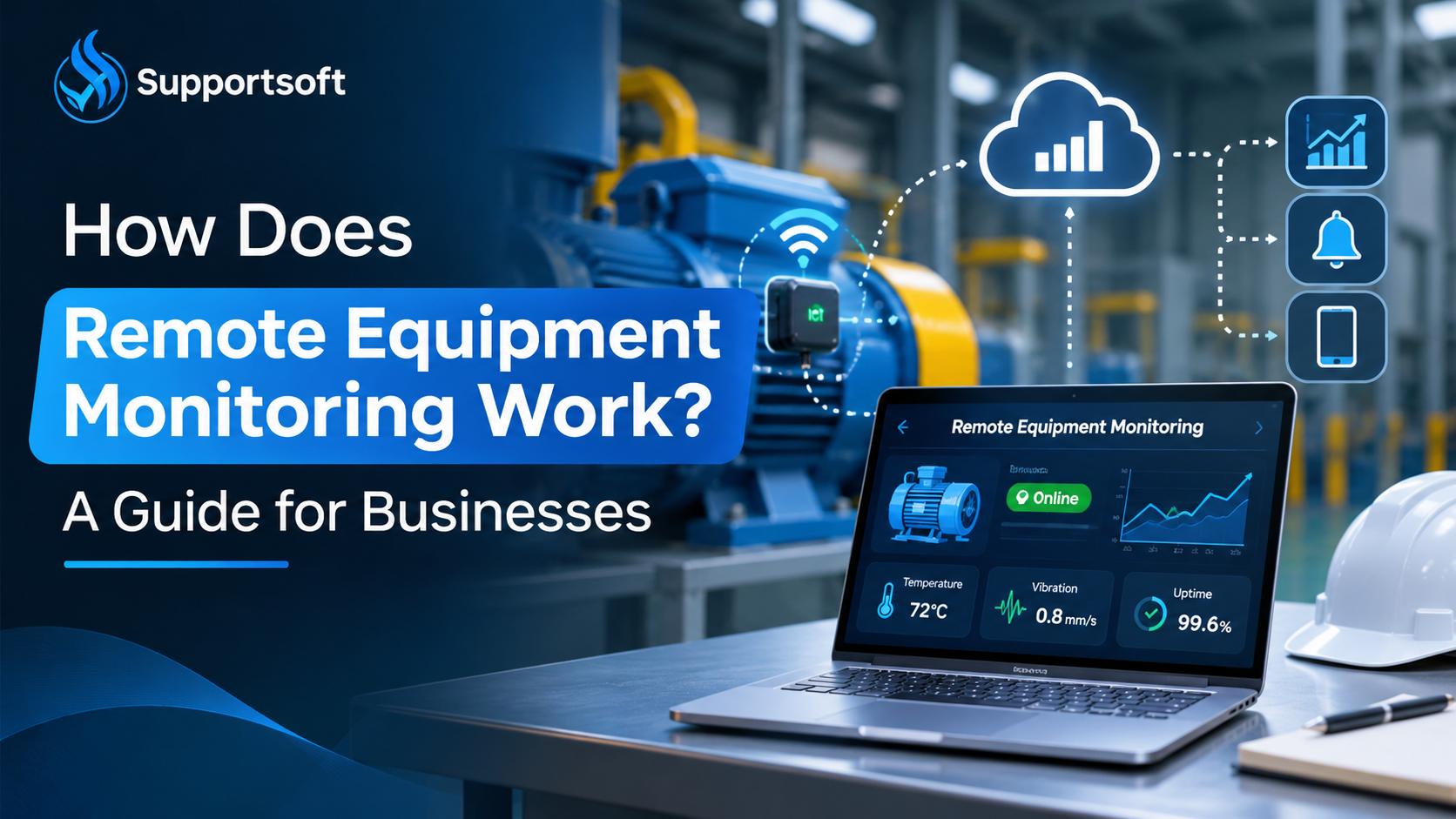
How Does Remote Equipment Monitoring Work? A Guide for Businesses

Supportsoft Nov 20, 2026
Businesses that rely on machinery, vehicles and industrial equipment need to understand how their assets are performing. Traditionally, equipment conditions were checked through physical inspections or manual reporting. These methods can make it difficult to identify problems between inspections or monitor assets across multiple locations.
Connected devices and Internet of Things (IoT) technology provide another approach. Sensors can collect information from equipment and transmit it to software platforms, allowing businesses to review operating conditions remotely. This can help teams identify unusual behaviour, investigate potential problems and make more informed maintenance decisions.
Introduction
Equipment monitoring is an important part of managing business operations. Manufacturing facilities, warehouses, construction companies, agricultural businesses and other industries depend on machinery and equipment to maintain productivity.
However, monitoring equipment across different locations can be challenging. Employees may need to conduct regular inspections, record operating measurements manually or travel to remote sites to check whether machinery is functioning correctly.
Remote equipment monitoring helps address some of these challenges by allowing businesses to collect and review equipment data without always needing someone physically present.
Using connected sensors, communication networks and monitoring software, organisations can track selected operating conditions, receive alerts and review equipment performance through a central platform.
But how does this technology actually work? What information can businesses monitor, and what infrastructure is required?
This guide explains the remote equipment monitoring process, its main components, practical applications and considerations businesses should understand before implementing a solution.
What Is Remote Equipment Monitoring?
Remote equipment monitoring is the process of collecting information about machinery or equipment from a distance using connected devices, sensors and software.
Instead of relying entirely on physical inspections, businesses can use electronic sensors to measure selected operating conditions and transmit the information to a central monitoring system.
Depending on the equipment and application, this information may include:
- Operating temperature
- Pressure levels
- Vibration measurements
- Equipment speed
- Energy consumption
- Operating hours
- Fuel levels
- Machine status
- Environmental conditions
The collected information can be displayed through a dashboard, stored for historical analysis or used to generate alerts when predefined conditions occur.
For example, a manufacturing business may install temperature and vibration sensors on production machinery. If a machine begins operating outside its expected temperature range, the monitoring system can notify the maintenance team.
This allows employees to investigate the issue without depending entirely on their next scheduled inspection.
Remote monitoring does not necessarily mean that equipment is controlled remotely. Monitoring and control are different capabilities. A monitoring system collects and presents information, while a remote control system may also allow authorised users to change equipment settings or issue commands.
The required functionality depends on the business application and its operational requirements.
How Does Remote Equipment Monitoring Work?
Remote equipment monitoring typically involves several connected components that work together to collect, transmit, process and display information.
Although the technical architecture varies between applications, the general process follows a series of steps.
Step 1: Sensors Collect Equipment Data
The process begins with sensors installed on or around the equipment being monitored.
These sensors measure physical conditions and convert them into data that can be processed by an electronic system.
For example:
- Temperature sensors measure heat levels
- Pressure sensors measure pressure within a system
- Vibration sensors detect movement and mechanical changes
- Current sensors measure electrical consumption
- Position sensors detect the location or movement of equipment
The type of sensor depends on what the business needs to monitor.
A business monitoring refrigeration equipment may prioritise temperature measurements, while a manufacturing facility may need vibration, pressure and operating-speed information.
Sensor selection should therefore be based on the equipment, operating environment and intended monitoring objectives.
Step 2: A Device or Gateway Collects the Information
Sensors may connect directly to a monitoring device or communicate through a gateway.
An IoT gateway acts as an intermediary between connected devices and the wider network.
It can collect information from multiple sensors, convert communication protocols where necessary, filter data and forward relevant information to another system.
For example, several sensors installed across a production facility may send readings to a local gateway. The gateway then transmits the collected information to a remote platform.
Some equipment includes built-in connectivity, while older machinery may require additional hardware to make monitoring possible.
Step 3: Data Is Transmitted Through a Network
After collection, the information needs to reach the monitoring platform.
The communication method depends on factors such as distance, data volume, power requirements, network availability and environmental conditions.
Common communication options include:
- Wi-Fi: Useful where reliable wireless network coverage is available
- Ethernet: Suitable for equipment connected through wired networks
- Bluetooth Low Energy (BLE): Useful for short-range communication with low-power devices
- Cellular networks: Suitable for equipment located away from fixed business networks
- LoRaWAN: Can support low-power communication over longer distances for suitable IoT applications
- Industrial communication protocols: Technologies such as Modbus and OPC UA may be used to exchange information with industrial equipment and control systems
Not every monitoring application needs an internet connection directly at each sensor. Some systems collect information locally and transmit it through a gateway at scheduled intervals.
The communication architecture should match the operating environment and the importance of receiving information quickly.
Step 4: Data Is Processed and Stored
Once information reaches the monitoring platform, it may be validated, organised and stored.
Depending on the system, processing may involve:
- Checking whether sensor readings are within expected ranges
- Converting information into standard units
- Removing duplicate or invalid readings
- Associating measurements with specific equipment
- Comparing current values with historical records
- Identifying unusual patterns
The platform may use cloud infrastructure, on-premises servers or a combination of both.
The choice depends on business requirements, connectivity, data security, infrastructure constraints and operational needs.
Step 5: Information Is Displayed Through a Dashboard
The processed information is made available to authorised users through a monitoring interface.
A dashboard may display:
- Current equipment status
- Live or periodically updated sensor readings
- Historical performance information
- Equipment operating hours
- Alerts and notifications
- Trends across multiple machines or locations
For example, a facilities manager responsible for several commercial buildings may use one dashboard to review temperature and energy measurements from different sites.
This centralised view can reduce the need to collect information manually from each location.
Step 6: Alerts Notify Teams About Unusual Conditions
A monitoring platform can be configured to generate alerts when measurements exceed defined thresholds or when specific conditions occur.
For instance, a business may configure an alert when:
- Equipment temperature rises above an acceptable limit
- Vibration measurements exceed a defined threshold
- A connected device stops transmitting data
- A machine operates outside its scheduled hours
- Energy consumption changes unexpectedly
Notifications may be delivered through the dashboard, email, SMS or an integrated business application.
However, an alert does not automatically confirm that equipment has failed. It indicates that a condition requires investigation.
Maintenance teams should review the information, assess the situation and decide what action is appropriate.
What Components Are Required for Remote Equipment Monitoring?
A remote monitoring system combines hardware, connectivity and software. Each component has a specific role in the overall process.
For businesses planning to connect equipment, sensors and monitoring software, Custom IoT Monitoring Solutions can help bring device connectivity, data processing and dashboard functionality together within a single system.
Sensors and connected devices
Sensors collect information about equipment conditions. Their specifications should match the measurements required and the environment in which they will operate.
For example, sensors used in outdoor or industrial environments may need suitable protection against moisture, dust, temperature variations and physical damage.
IoT gateways and communication hardware
Gateways connect sensors and equipment to the monitoring network.
They may also perform local processing, protocol conversion and temporary data storage when network connectivity is interrupted.
Network infrastructure
The communication network transfers information between connected equipment and the monitoring platform.
Businesses should consider coverage, reliability, bandwidth, latency and ongoing connectivity costs.
Backend systems and databases
Backend software receives, processes and manages information from connected devices.
It may handle device registration, data validation, user authentication, alert rules and communication with other business systems.
Databases store current and historical information so users can review equipment behaviour over time.
Monitoring dashboards and applications
The user interface presents equipment information in a format that employees can understand and act upon.
Depending on the project, this may be a web-based dashboard, a mobile application or an interface integrated into an existing business platform.
A well-designed monitoring interface should make important information easy to identify without overwhelming users with unnecessary measurements.
Where Can Businesses Use Remote Equipment Monitoring?
Remote equipment monitoring can support a range of industries. The specific application depends on the equipment being used and the operating conditions that need to be monitored.
Manufacturing and industrial facilities
Manufacturing businesses rely on production machinery, motors, compressors, pumps and other equipment.
Sensors can help monitor temperature, vibration, operating hours and other indicators.
Maintenance teams can use this information to investigate unusual conditions and understand how machinery performs during operation.
For example, monitoring vibration levels on industrial motors may help identify changes that require further inspection.
Construction and heavy equipment
Construction companies may operate machinery across several job sites.
Remote monitoring can help track equipment location, operating hours, usage patterns and selected machine conditions.
This information can support equipment utilisation reviews and help businesses understand where assets are being used.
Agriculture
Agricultural operations often depend on pumps, irrigation systems, storage equipment and environmental monitoring devices.
Connected sensors can help farmers review water levels, pump performance, soil moisture and other relevant measurements.
Remote access can be particularly useful when equipment is distributed across large properties.
Warehousing and cold storage
Temperature-sensitive storage facilities need to maintain appropriate environmental conditions.
Monitoring systems can track temperature and humidity measurements and notify employees when conditions move outside configured limits.
This can help staff investigate potential problems before they affect stored goods.
Energy and utilities
Energy-related businesses may use connected monitoring systems to review equipment status, energy consumption and operating conditions.
Monitoring can support operational visibility across facilities and distributed assets.
The specific measurements and response procedures depend on the equipment and the business's operational requirements.
How Does Remote Equipment Monitoring Support Predictive Maintenance?
One important application of remote equipment monitoring is its role in maintenance planning.
Traditional maintenance approaches often include scheduled servicing and repairs after equipment problems occur.
Remote monitoring can provide additional information that helps maintenance teams understand how equipment is performing between scheduled inspections.
From scheduled maintenance to condition-based monitoring
Scheduled maintenance is generally performed according to defined time intervals or usage levels.
Condition-based maintenance uses information about the actual condition of equipment to help determine when inspection or maintenance may be appropriate.
For example, a business may monitor vibration and temperature measurements from a machine. If these readings begin to change, the maintenance team can investigate whether the equipment requires attention.
Understanding predictive maintenance
Predictive maintenance uses equipment data and analytical techniques to estimate when a failure or maintenance requirement may occur.
Depending on the application, it may involve:
- Historical equipment measurements
- Operating conditions
- Maintenance records
- Sensor trends
- Statistical analysis
- Machine learning models
Remote monitoring can supply some of the information required for these methods.
However, collecting sensor data alone does not automatically create a predictive maintenance system. Reliable predictions require suitable data, appropriate analytical methods and validation against actual equipment behaviour.
Businesses should distinguish between a basic threshold-based alert system and a more advanced predictive model.
What Are the Benefits of Remote Equipment Monitoring?
The value of remote equipment monitoring depends on how effectively the collected information supports business decisions.
Some potential benefits include:
Improved operational visibility
Businesses can review equipment information from a central location instead of relying entirely on manual reporting.
This can be useful when assets are spread across different sites or locations.
Faster identification of unusual conditions
Alerts can help employees become aware of selected equipment conditions without waiting for the next scheduled inspection.
This does not guarantee that every problem will be detected, but it can improve awareness of monitored conditions.
Better-informed maintenance planning
Historical readings and equipment trends can help maintenance teams understand changes in operating conditions.
This information can support decisions about inspections, servicing and further investigation.
Reduced need for routine manual checks
Where remote monitoring is suitable, employees may be able to review certain equipment measurements without physically visiting each asset.
Physical inspections may still be necessary for safety, compliance and maintenance purposes.
Improved equipment utilisation
Monitoring operating hours, location and usage patterns can help businesses understand how equipment is being used.
This may support better planning of asset allocation and maintenance schedules.
Historical performance information
Stored equipment data can help businesses compare performance over time and investigate recurring issues.
It may also support operational reporting and longer-term improvement initiatives.
What Challenges Should Businesses Consider?
Although remote equipment monitoring can provide useful operational information, implementation involves several practical considerations.
Connectivity limitations
Equipment located underground, in remote areas or within industrial buildings may experience unreliable network coverage.
Businesses should assess connectivity at the actual installation locations before selecting a communication technology.
Some systems may require local data storage or alternative communication arrangements when connectivity is unavailable.
Sensor accuracy and reliability
Incorrect or unreliable sensor readings can lead to misleading conclusions.
Sensor specifications, installation quality, calibration requirements and environmental suitability should be evaluated carefully.
Integration with existing equipment
Older machinery may not support modern connectivity methods or provide direct access to operational data.
Additional sensors, gateways or protocol converters may be needed.
Before implementation, assess whether the existing equipment can supply the information required.
Data security
Connected devices create additional points that need to be protected.
Security planning should consider:
- Device authentication
- Secure communication
- Access permissions
- Firmware updates
- Network separation where appropriate
- Data storage and retention
- Monitoring for unusual access or behaviour
Businesses should also clarify who is responsible for maintaining device security and updating connected hardware.
Managing large volumes of data
Monitoring multiple assets can generate significant amounts of information.
Collecting every available measurement may not be necessary or useful.
Businesses should identify which data is relevant to operational decisions and define suitable collection intervals, storage requirements and retention policies.
How Should Businesses Plan a Remote Equipment Monitoring System?
Before investing in a monitoring solution, businesses should establish what they need to monitor and how the information will be used.
A structured planning process can help reduce unnecessary complexity.
Step 1: Identify the equipment
List the machines, vehicles or assets that need monitoring.
Record their location, operating conditions, existing communication capabilities and maintenance requirements.
Step 2: Define the monitoring objectives
Decide what information the business needs and why.
For example, the objective may be to monitor temperature, understand equipment utilisation or receive notifications when machinery operates outside expected conditions.
Avoid collecting data without a clear operational purpose.
Step 3: Select suitable sensors and connectivity
Choose sensors based on the required measurements and operating environment.
Then determine how the devices will communicate with gateways and the monitoring platform.
Step 4: Plan the software architecture
The solution may require device management, backend processing, data storage, dashboards, alert configuration and integration with existing business applications.
These components should be planned together to ensure the system can support the intended workflow.
Step 5: Start with a controlled implementation
A pilot involving a limited number of assets can help evaluate sensor performance, connectivity, dashboard usability and alert accuracy.
The pilot should use realistic operating conditions and clearly defined evaluation criteria.
Step 6: Establish ongoing maintenance responsibilities
Define who will manage device updates, sensor calibration, connectivity issues, software maintenance, data security and user access.
A monitoring system requires ongoing attention to remain reliable.
Conclusion
Remote equipment monitoring allows businesses to collect and review machinery information through connected sensors, communication networks and software platforms.
By understanding equipment conditions, receiving alerts and reviewing historical measurements, organisations can improve operational visibility and make more informed maintenance decisions.
However, successful implementation requires more than installing sensors. Businesses need to select appropriate hardware, establish reliable connectivity, plan the software architecture and consider security, integration and ongoing maintenance.
A practical starting point is to identify a specific monitoring requirement and test the approach with a limited group of assets. This helps businesses understand the technical requirements and operational value before expanding the system across additional equipment.
With suitable planning, remote monitoring can become a useful part of a broader connected-device
Frequently Asked Questions
What is the purpose of remote equipment monitoring?
Remote equipment monitoring allows businesses to collect and review information about machinery and assets from a distance. It can help teams understand operating conditions, identify unusual measurements and support maintenance planning.
How does IoT enable remote equipment monitoring?
IoT connects sensors, equipment and software platforms through communication networks. Sensors collect information, gateways or connected devices transmit it, and monitoring software processes and displays the data.
What types of equipment can be monitored remotely?
Depending on sensor compatibility and connectivity, businesses can monitor manufacturing machinery, pumps, motors, generators, refrigeration systems, vehicles, agricultural equipment and other connected assets.
Does remote equipment monitoring require an internet connection?
Many systems use internet connectivity to transmit information to cloud-based platforms. However, some applications can collect and process information locally, storing it until a connection becomes available. The architecture depends on the operating environment and monitoring requirements.
What is the difference between remote monitoring and predictive maintenance?
Remote monitoring collects and displays equipment information, while predictive maintenance uses equipment data and analytical methods to estimate potential maintenance needs or failures. Remote monitoring can provide valuable input for predictive maintenance, but the two are not the same.
Can remote equipment monitoring work with older machinery?
Yes, in many cases. Older equipment may be connected using additional sensors, gateways or communication interfaces. The available options depend on the machinery, accessible data and installation conditions.
Is remote equipment monitoring suitable for small businesses?
It can be useful for small businesses that depend on equipment and need better visibility into its operating conditions. The business should first assess whether the expected operational value justifies the hardware, connectivity, software and maintenance costs.
What should businesses consider before implementing remote monitoring?
Businesses should identify the assets to monitor, define the required measurements, assess connectivity, choose suitable sensors, plan software integrations and establish security and maintenance responsibilities.