
 Mobile App Development
 Software Development
 AI Solutions & Automation
 IoT Solutions
 Web Development
 Cyber Security
What Are the Main Components of an Industrial IoT System?

Supportsoft Nov 23, 2026
Industrial operations increasingly rely on connected technologies to collect equipment data, monitor processes and improve operational visibility. An Industrial Internet of Things (IIoT) system brings together physical equipment, sensors, communication networks, software platforms and data-processing tools to connect industrial environments with digital applications.
Understanding these components is important for businesses planning to introduce equipment monitoring, predictive maintenance, production tracking or other connected industrial applications. Each component has a specific role, and the overall system must be designed to ensure that devices can communicate reliably, data can be processed effectively and authorised users can access useful information.
Introduction
Industrial IoT connects machinery, sensors, industrial control systems and software applications to create a more connected operational environment. Instead of relying entirely on manual inspections and isolated equipment readings, businesses can collect and review data from connected assets through centralised systems.
For example, a manufacturing facility may use sensors to measure machine temperature, vibration and operating speed. An industrial gateway can collect this information and transmit it to an IoT platform, where the data is processed and displayed through dashboards. If a reading exceeds a configured threshold, the system can notify the relevant maintenance team.
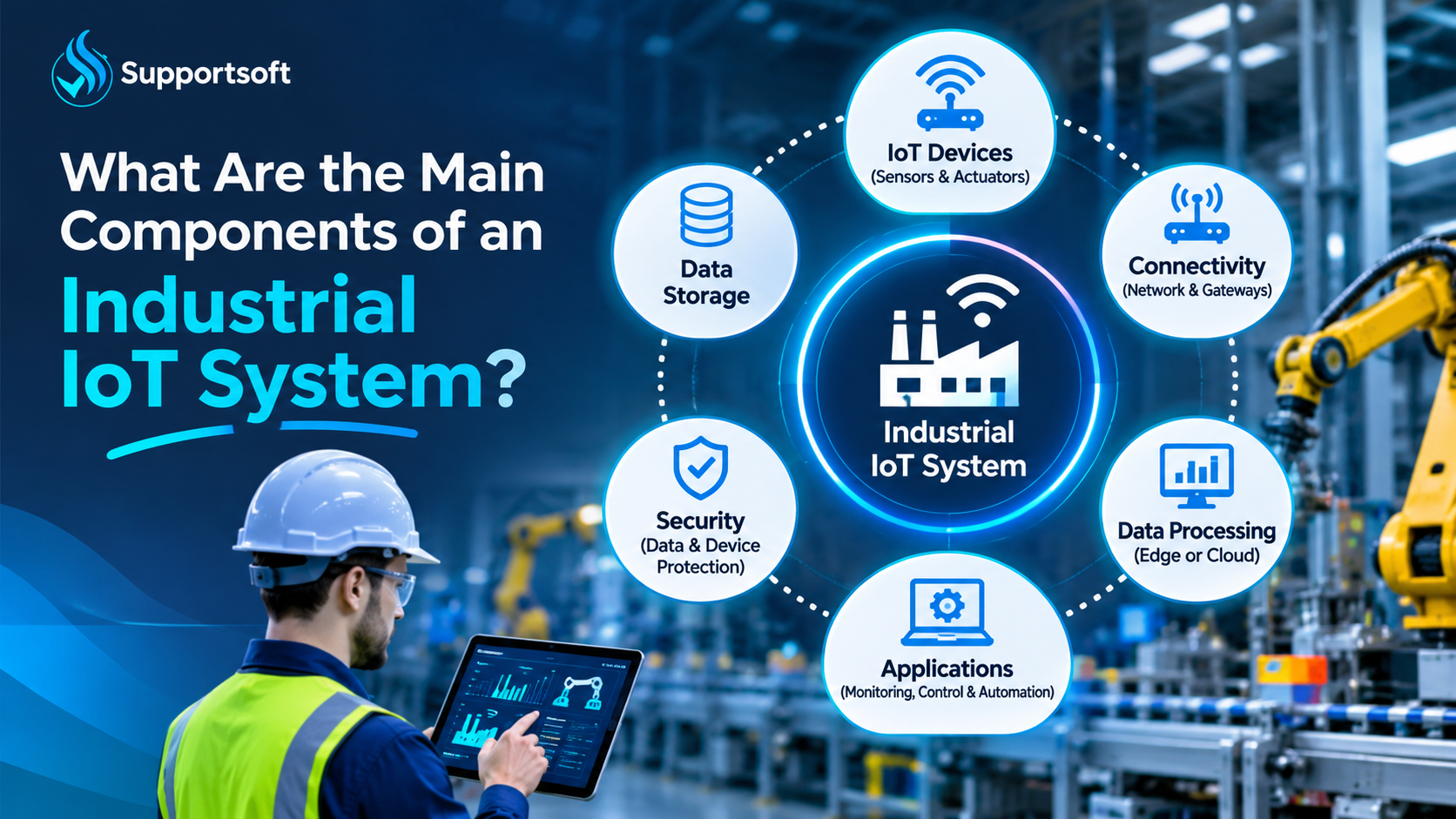
An effective industrial IoT system generally includes several interconnected components:
- Sensors and connected devices
- Industrial machinery and control systems
- Edge devices and IoT gateways
- Communication networks and protocols
- IoT platforms and cloud infrastructure
- Data storage and processing systems
- Analytics and artificial intelligence
- User applications and monitoring dashboards
- Security and device management mechanisms
The exact architecture depends on the industrial environment, the equipment involved, connectivity requirements and the business objectives.
How AI Is Supporting Modern Industrial IoT Systems
Artificial intelligence is becoming an important addition to industrial IoT environments. When combined with sensor readings and historical equipment data, AI and machine learning models can help identify unusual operating patterns, support predictive maintenance and provide insights into equipment performance.
However, AI is not a mandatory component of every industrial IoT system. A business can begin with basic monitoring, data collection and alerting, then introduce AI capabilities when its data quality, operational requirements and infrastructure support them.
Sensors and Connected Devices
Sensors are among the most important components of an industrial IoT system because they collect information from physical equipment and operating environments.
They convert measurable physical conditions into data that connected systems can process and analyse.
Common Types of Industrial IoT Sensors
Different industrial applications require different sensor types.
- Temperature sensors: Measure the temperature of machinery, motors, production equipment and industrial environments.
- Pressure sensors: Monitor pressure levels in pipelines, hydraulic systems, tanks and industrial machinery.
- Vibration sensors: Detect equipment vibration patterns that may indicate imbalance, wear or mechanical problems.
- Humidity sensors: Measure moisture levels in storage facilities, manufacturing environments and controlled spaces.
- Proximity sensors: Detect the presence or movement of objects without requiring physical contact.
- Flow sensors: Measure the movement of liquids, gases or other materials through industrial systems.
- Position sensors: Track the position or movement of machinery and mechanical components.
- Energy monitoring sensors: Collect information about electricity consumption and equipment energy usage.
How Sensors Contribute to Industrial Monitoring
Consider a manufacturing business that operates several industrial motors. Vibration and temperature sensors can continuously collect readings from these machines.
The collected data can help maintenance teams:
- Monitor equipment operating conditions
- Identify unusual changes in sensor readings
- Review historical performance patterns
- Receive alerts when readings exceed configured limits
- Investigate potential equipment problems
Sensor selection should be based on measurement accuracy, operating conditions, environmental resistance, installation requirements and compatibility with the wider system.
Industrial Machinery and Control Systems
Industrial IoT systems often connect with existing machinery and operational technology rather than replacing all existing equipment.
Industrial machines, programmable logic controllers (PLCs), supervisory control and data acquisition (SCADA) systems and distributed control systems (DCS) can provide valuable operational information.
Programmable Logic Controllers (PLCs)
PLCs are industrial computers designed to control machinery and automated processes.
They receive inputs from sensors, execute programmed control logic and send outputs to equipment such as motors, valves and actuators.
Within an IIoT environment, a PLC may provide information about:
- Machine operating status
- Production cycle activity
- Equipment temperature
- Process conditions
- Fault codes and machine alarms
An IoT system can collect selected information from compatible PLCs to support monitoring and reporting.
SCADA Systems
SCADA systems help industrial operators monitor and control processes across equipment and facilities.
They commonly provide:
- Real-time process monitoring
- Operator interfaces
- Alarm management
- Historical data collection
- Remote supervisory control
An Industrial IoT platform can complement an existing SCADA environment by connecting operational information with additional analytics, reporting tools and business applications.
DCS and Other Industrial Control Systems
Distributed control systems are commonly used to manage complex industrial processes across multiple control points.
Depending on the environment, IIoT architecture may integrate with DCS platforms, industrial controllers and other operational technology systems.
Integration should be carefully planned to avoid disrupting critical control operations.
Edge Devices and IoT Gateways
Edge devices and IoT gateways connect industrial equipment with wider communication networks and software platforms.
They are particularly important in industrial environments where large volumes of data are generated by machines and sensors.
What Is an Industrial IoT Gateway?
An IoT gateway acts as an intermediary between connected devices and an IoT platform.
It can collect data from multiple devices, translate communication protocols and forward information to the appropriate system.
Common gateway functions include:
- Collecting data from connected sensors and controllers
- Translating supported industrial communication protocols
- Filtering unnecessary or duplicate readings
- Forwarding information to cloud or on-premises platforms
- Managing communication between devices and applications
- Supporting secure device connectivity
What Is Edge Computing?
Edge computing processes data closer to where it is generated rather than sending every reading to a remote cloud platform.
For example, a production facility may process machine vibration readings through an industrial edge computer. The device can identify whether a reading exceeds a configured threshold and send an alert without waiting for cloud processing.
Benefits of Edge Processing
- Reduced latency: Certain decisions can be made closer to the equipment.
- Lower bandwidth requirements: Unnecessary data may be filtered before transmission.
- Improved operational continuity: Some edge applications can continue processing locally during temporary connectivity interruptions.
- Local data handling: Sensitive or time-critical information can be processed within the facility.
Edge computing does not replace cloud infrastructure in every architecture. Many industrial systems combine local processing with centralised cloud or on-premises services.
Communication Networks and Protocols
Industrial IoT devices need reliable communication methods to exchange information with gateways, control systems and software platforms.
The appropriate connectivity option depends on the facility layout, equipment requirements, data volume, transmission distance and environmental conditions.
Common Industrial IoT Connectivity Technologies
- Industrial Ethernet: Provides wired connectivity for industrial devices and control systems.
- Wi-Fi: Supports wireless connectivity within suitable facility environments.
- Bluetooth Low Energy (BLE): Can connect compatible low-power devices and sensors over shorter distances.
- Cellular networks: Technologies such as 4G and 5G can support connectivity across geographically distributed assets.
- LoRaWAN: Supports long-range, low-power communication for suitable sensor applications.
- Wired serial connections: Interfaces such as RS-232 and RS-485 are used by many industrial devices and controllers.
Common Industrial Communication Protocols
| Protocol | Typical purpose |
|---|---|
| Modbus | Communication with industrial controllers, meters and equipment |
| OPC UA | Structured and interoperable industrial data exchange |
| MQTT | Lightweight messaging between connected devices and platforms |
| PROFINET | Industrial Ethernet communication and automation |
| EtherNet/IP | Industrial communication between automation devices |
| CAN bus | Communication between compatible controllers and embedded devices |
Not every protocol is suitable for every application. Businesses should assess device compatibility, security requirements, network performance and integration complexity before selecting a communication approach.
IoT Platform and Cloud Infrastructure
An IoT platform provides the software environment required to connect devices, manage incoming information and make collected data available to applications.
It acts as a central layer between connected equipment and the software used by industrial teams.
Main Functions of an IoT Platform
An industrial IoT platform may provide:
- Device registration and management
- Device communication and connectivity
- Data ingestion from gateways and sensors
- Data storage and retrieval
- Device status monitoring
- Alert and event management
- Integration with external applications
- Access control and user management
Cloud-Based IoT Infrastructure
Cloud infrastructure allows businesses to process and store information using remotely managed computing resources.
It can support industrial environments that need to monitor equipment across multiple locations or provide access to operational data through centralised applications.
Common cloud capabilities include:
- Scalable data storage
- Application hosting
- Data processing services
- Backup and recovery
- Integration with business systems
- Remote access to monitoring applications
On-Premises and Hybrid Infrastructure
Cloud infrastructure is not always the preferred option for industrial environments.
Some businesses need to keep certain operational data within their own facilities because of security policies, regulatory requirements, connectivity limitations or operational constraints.
A hybrid architecture can combine local infrastructure and cloud services. For example, time-sensitive processing may happen on-site, while selected historical data is transferred to a cloud platform for reporting and long-term analysis.
Data Storage and Processing Systems
Industrial IoT systems can generate large amounts of information from sensors, machines and connected devices.
Data storage and processing components help organise this information so it can be retrieved, analysed and used by applications.
Data Storage Options
Different types of industrial data may require different storage technologies.
- Time-series databases: Store measurements associated with timestamps, such as temperature, pressure and vibration readings.
- Relational databases: Store structured information, including equipment records, users, maintenance schedules and operational data.
- Object storage: Retains files such as logs, reports, images and larger data exports.
- Data lakes: Can store large volumes of raw or processed information from different sources for further analysis.
The appropriate storage design depends on data volume, retention requirements, access patterns and reporting needs.
Data Processing Activities
Before industrial data becomes useful, it may need to be processed and organised.
Common processing activities include:
- Receiving data from sensors, gateways and industrial controllers
- Validating incoming readings
- Standardising data formats and timestamps
- Filtering incomplete or irrelevant records
- Organising information by equipment, location or process
- Storing the data for monitoring and analysis
- Making relevant information available to dashboards and other applications
Data quality is important. Incorrect timestamps, missing readings or inconsistent device identifiers can affect reporting and operational decisions.
Data Analytics and Artificial Intelligence
Data analytics helps businesses interpret industrial information and identify patterns that may not be obvious from individual sensor readings.
An IIoT system can use basic rules, statistical analysis or more advanced machine learning techniques depending on the available data and operational requirements.
Types of Industrial IoT Analytics
Descriptive analytics
Explains what has happened by presenting historical information, equipment readings and operational trends.
Example: Reviewing how frequently a production machine has stopped during a particular period.
Diagnostic analytics
Helps investigate why a particular event or change occurred.
Example: Comparing temperature and vibration readings to investigate a machine performance issue.
Predictive analytics
Uses historical data and analytical models to estimate the likelihood of future events.
Example: Identifying patterns that may indicate an increased risk of equipment failure.
Prescriptive analytics
Evaluates possible actions based on available data, constraints and analytical models.
Example: Supporting maintenance planning by comparing equipment condition, operating schedules and maintenance requirements.
How AI and Machine Learning Support IIoT
AI and machine learning can extend the analytical capabilities of an industrial IoT system.
Potential applications include:
- Detecting unusual equipment behaviour
- Identifying patterns associated with equipment deterioration
- Supporting predictive maintenance
- Analysing production quality data
- Forecasting selected operational conditions
- Helping teams investigate complex data patterns
AI predictions should not automatically be treated as confirmed equipment faults. Models require appropriate training data, validation, monitoring and human oversight.
User Applications and Monitoring Dashboards
The data collected by an Industrial IoT system needs to be accessible to the people responsible for monitoring and managing operations.
User applications and dashboards provide an interface through which authorised users can review equipment information and respond to relevant events.
Common Features of Industrial IoT Dashboards
An industrial monitoring dashboard may include:
- Real-time equipment status
- Sensor readings and historical trends
- Machine availability information
- Production performance indicators
- Equipment location information
- Configured alerts and notifications
- Maintenance records
- Reports and operational summaries
Web and Mobile Applications
Web applications can provide centralised monitoring interfaces for operators, supervisors and management teams.
Mobile applications can help authorised users access selected information when they are away from their workstations.
For example, a maintenance manager may use a mobile application to review an equipment alert, check the latest sensor readings and assign an inspection task.
The application should present information clearly, provide suitable access permissions and support the workflows required by its intended users.
Alerting and Notification Systems
An alerting system helps industrial teams identify conditions that require attention.
It uses configured rules or analytical outputs to generate notifications when specific events occur.
Common Industrial IoT Alerts
- Equipment temperature exceeds a defined threshold
- Machine vibration readings change beyond an acceptable range
- A connected device stops communicating
- Pressure readings move outside configured limits
- The equipment reports a fault code
- Energy consumption differs from an expected operating pattern
How an Alerting System Works
A typical alert workflow involves:
- A sensor or industrial controller generates a reading or event
- The gateway or platform receives the information
- The system evaluates the reading against configured rules
- An alert is generated when the relevant condition is met
- The notification is delivered to an authorised user or monitoring application
- The event is recorded for investigation and reporting
Alert configuration should account for normal operating conditions. Poorly configured thresholds can generate excessive notifications and make important events harder to identify.
Security and Device Management
Security is a fundamental requirement of Industrial IoT architecture. Connected devices, industrial networks and software platforms can create additional entry points that need to be protected.
Security controls should consider both information technology (IT) and operational technology (OT) environments.
Important Industrial IoT Security Components
Device authentication
Devices should be identified and authenticated before they are permitted to communicate with authorised systems.
Encryption
Appropriate encryption can protect information while it travels across communication networks and when it is stored.
Access control
Users and connected systems should receive permissions based on their responsibilities and operational requirements.
Network segmentation
Separating industrial networks from general business networks can help limit unnecessary communication and reduce the impact of certain security incidents.
Secure firmware and software updates
Connected devices and gateways need a controlled process for applying security patches and software updates.
Monitoring and logging
Security logs and device activity records can help teams investigate unusual behaviour and identify potential issues.
Why Device Management Matters
Industrial IoT systems may include hundreds or thousands of connected devices across multiple facilities.
Device management helps businesses:
- Register and identify connected devices
- Monitor device availability
- Track software and firmware versions
- Apply authorised configuration changes
- Manage device credentials
- Monitor connectivity and communication failures
- Maintain an inventory of connected assets
Security and device management should be included in the system architecture from the beginning rather than added only after deployment.
How Do the Components of an Industrial IoT System Work Together?
The components of an industrial IoT system operate as connected layers. Each layer performs a specific task, but the system becomes useful when information can move reliably between them.
Consider an industrial facility that wants to monitor the condition of its production machinery.
A typical data flow may work as follows:
- Data collection: Sensors measure machine temperature, vibration and operating conditions.
- Equipment communication: Compatible PLCs and controllers provide additional machine information.
- Edge processing: An industrial gateway collects readings, filters information and performs local processing where required.
- Data transmission: The gateway sends relevant information through a suitable industrial network.
- Platform ingestion: The IoT platform receives the incoming data and identifies the associated devices.
- Data storage: Readings are stored for monitoring, historical analysis and reporting.
- Analytics: Rules or analytical models identify unusual patterns and changes in operating conditions.
- Dashboard presentation: The monitoring application displays equipment information to authorised users.
- Alert generation: The notification system informs relevant personnel when configured conditions are met.
- Operational response: Maintenance or operations teams investigate the event and take appropriate action.
This architecture allows businesses to connect physical operations with digital monitoring and management systems.
The actual design may vary. Some systems process most information locally, while others rely more heavily on cloud infrastructure. Critical industrial control functions should remain appropriately separated from monitoring and analytics applications.
What Should Businesses Consider When Building an Industrial IoT System?
Selecting the right components is only one part of an industrial IoT project. Businesses also need to consider how the complete system will operate within their existing technical and operational environment.
Define the Business Objective
Start by identifying the problem the system is expected to address.
Possible objectives include:
- Monitoring equipment performance
- Improving asset visibility
- Supporting predictive maintenance
- Tracking production activity
- Monitoring environmental conditions
- Reducing manual data collection
- Improving operational reporting
A clearly defined objective helps determine which components are necessary.
Assess Existing Equipment and Infrastructure
Review the machinery, controllers, sensors and networks already used within the facility.
Consider:
- Whether existing equipment supports digital communication
- Which protocols and interfaces are available
- Whether additional sensors or gateways are required
- Whether existing control systems can provide the necessary information
- Whether the facility has suitable network coverage
Plan for Scalability
The system should be capable of accommodating future devices, facilities, data sources and application requirements.
Scalability considerations include device capacity, data storage, network performance, platform architecture and ongoing maintenance.
Evaluate Security and Reliability
Businesses should assess authentication, encryption, access control, network segmentation, backup arrangements and recovery procedures.
Industrial environments may also require redundancy and local processing to maintain essential monitoring capabilities during connectivity interruptions.
Consider Software Integration
An IIoT system may need to exchange information with existing business applications, maintenance management software, enterprise resource planning (ERP) systems or reporting platforms.
Integration requirements should be identified before development begins.
When businesses need to connect industrial equipment, device data and software applications, Custom IoT Monitoring Solutions can be planned around their equipment, communication protocols, operational workflows and monitoring requirements.
Conclusion
An industrial IoT system combines physical devices, industrial control systems, communication networks, gateways, software platforms and data-processing technologies to connect industrial operations with digital applications.
Each component contributes to the system's ability to collect information, transfer data, monitor equipment and support operational decisions. Sensors provide measurements, gateways connect devices, platforms manage information, analytics identify patterns and applications make the results accessible to authorised users.
Businesses planning an IIoT project should begin with clear operational objectives and assess their existing equipment, connectivity, security and integration requirements. A well-planned architecture can provide a practical foundation for equipment monitoring, operational visibility and future industrial digitalisation.
Frequently Asked Questions
What are the main components of an industrial IoT system?
The main components typically include sensors, connected industrial equipment, PLCs and control systems, IoT gateways, communication networks, IoT platforms, data storage, analytics, user dashboards, alerting systems and security mechanisms.
What is the role of sensors in industrial IoT?
Sensors collect information about physical conditions such as temperature, pressure, vibration, humidity and flow. They convert these measurements into data that can be transmitted to connected systems for monitoring and analysis.
What is an IoT gateway in an industrial system?
An IoT gateway connects industrial devices and sensors with an IoT platform or other software systems. It can collect information, translate supported protocols, filter data and manage communication between connected equipment and applications.
What is the difference between edge computing and cloud computing in IIoT?
Edge computing processes data close to the equipment that generates it, which can support low-latency decisions and local operations. Cloud computing uses remote infrastructure for data storage, processing and application hosting. Industrial systems can combine both approaches.
Which communication protocols are used in Industrial IoT?
Common protocols include Modbus, OPC UA, MQTT, PROFINET, EtherNet/IP and CAN bus. The appropriate protocol depends on equipment compatibility, communication requirements and the industrial environment.
How does an Industrial IoT platform work?
An industrial IoT platform connects devices, receives information from gateways and sensors, manages device communication, stores data and makes it available to applications. It may also support alerts, analytics and integration with other business systems.
How does AI support industrial IoT systems?
AI and machine learning can analyse industrial data to identify unusual patterns, support predictive maintenance, detect potential equipment issues and improve operational insights. Their effectiveness depends on data quality, model validation and appropriate deployment.
Why is cybersecurity important in industrial IoT?
Industrial IoT systems connect physical equipment with digital networks and applications. Security controls help protect connected devices, operational data and industrial systems from unauthorised access, disruption and other cyber risks.
Can Industrial IoT systems integrate with existing machinery?
Yes, many industrial IoT systems can integrate with existing machinery through compatible sensors, PLCs, industrial gateways and communication protocols. The feasibility depends on equipment interfaces, available data and the requirements of the existing control environment.
What is the difference between IoT and Industrial IoT?
IoT is a broad term for connected devices that collect and exchange data across different environments. Industrial IoT focuses on connected technologies used in industrial settings, including manufacturing, energy, logistics and infrastructure. IIoT systems often have additional requirements for reliability, operational safety, security and integration with industrial control systems.