
 Mobile App Development
 Software Development
 AI Solutions & Automation
 IoT Solutions
 Web Development
 Cyber Security
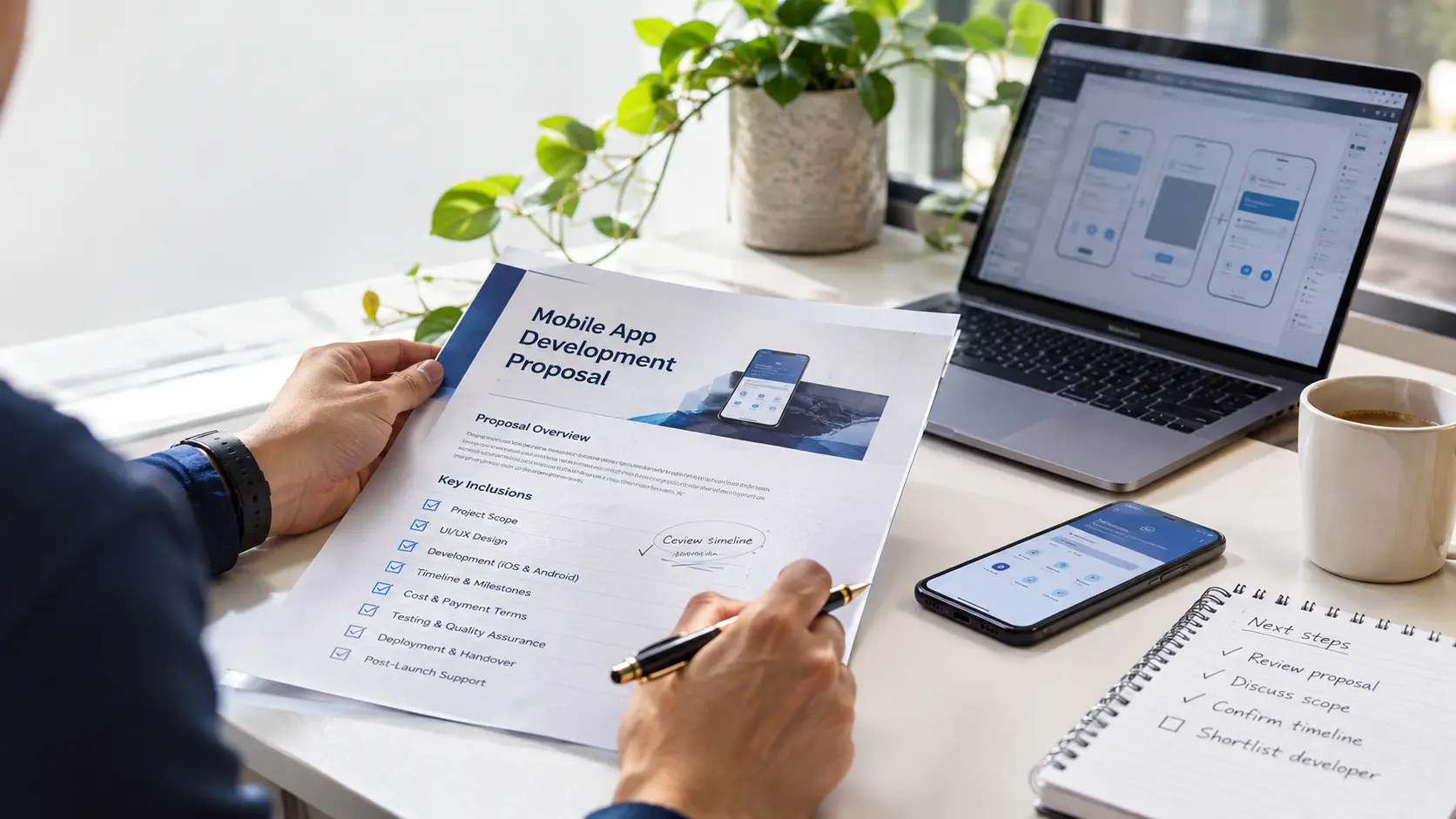

Building a mobile app involves more than choosing a few features and deciding how much money to spend. Before development starts, you need a clear understanding of what will be built, how the project will progress, what the developer will deliver and what responsibilities each party will have.
This is where a mobile app development proposal becomes important.
A proposal gives you an opportunity to review the development team's understanding of your idea, the proposed technical approach, project scope, estimated costs and delivery expectations before making a commitment.
For businesses planning a new application, understanding the scope of mobile app development services in Australia can also help clarify the planning, design, development and technical requirements that may need to be included in a proposal.
However, not every proposal covers these details properly. Some documents provide a general project summary and estimated price without explaining the functionality, integrations, testing or responsibilities involved. Others contain technical terminology without making it clear what you will actually receive.https://supportsoft.com.au/mobile-app-developer-australia
Understanding what should be included in a proposal makes it easier to compare different options, identify missing information and ask the right questions before moving forward.
In this guide, we explain the main elements to review, common warning signs to look out for and how to compare proposals before choosing a development partner.
Why Reviewing a Mobile App Development Proposal Matters Before You Sign
An app development proposal sets out how a development team understands your requirements and intends to approach the project.
It helps bring business expectations and technical responsibilities into one documented plan. Instead of relying entirely on conversations or informal estimates, you can review the proposed work before development begins.
A well-prepared proposal should help you understand:
- What problem the application is intended to solve.
- Which users will use the application.
- What features and functionality are included.
- Which platforms and technologies are being considered.
- How long the project may take.
- What the estimated investment covers.
- What deliverables you will receive.
- How testing, deployment and ongoing support will be handled.
It also gives you something concrete to discuss when reviewing different development options.
For example, two proposals may provide similar total prices, but one might include UI/UX design, backend development, payment integration, testing and deployment, while the other covers only the initial application build.
Without understanding the scope behind each estimate, it is difficult to make a fair comparison.
The goal is not simply to find the cheapest proposal. It is to understand what is being offered, what is excluded and whether the proposed approach matches your business requirements.
What Should a Mobile App Development Proposal Include?
A useful proposal should explain the project from its initial requirements through development, delivery and post-launch responsibilities.
The following sections provide a practical framework for reviewing what a development team has proposed.
1. Executive Summary and Project Overview
The executive summary should give you a clear overview of the proposed application and the work involved.
It should briefly explain your business idea, the problem you want to address and the solution the development team is recommending.
The project overview can then provide more detail about the application itself.
Look for information such as:
- The purpose of the application.
- The business problem it is intended to address.
- The main users of the application.
- The type of application being proposed.
- The expected project outcome.
- The development team's understanding of your requirements.
For example, consider a business planning an appointment booking application.
A useful project overview would explain who will make bookings, how service providers will manage availability, how customers will receive confirmations and whether administrators need a separate management interface.
A proposal that only says "build an appointment booking app" does not provide enough detail to understand what the project involves.
2. Business Goals, Target Users and App Requirements
An application should be planned around a real business requirement rather than a collection of features.
The proposal should explain what the business wants to achieve and who the application is being developed for.
This helps determine which features are necessary, how the interface should work and what the development team needs to consider during planning.
Check whether the proposal identifies:
- The primary target users.
- Their main needs and expectations.
- Important business objectives.
- The problems the application should solve.
- Expected user journeys.
- Functional and non-functional requirements.
Functional requirements describe what users should be able to do. These might include creating an account, booking a service, uploading documents or making payments.
Non-functional requirements describe how the application should perform. Examples include security, availability, response times, accessibility and compatibility with supported devices.
If these requirements are not understood at the beginning, the project may need additional discussions and changes later.
3. Project Scope, Features and Deliverables
The project scope is one of the most important parts of a development proposal.
It explains what the development team will build and which activities are included in the agreed work.
Ask the developer to provide a clear list of proposed features, screens, user roles and functionality.
For example, an appointment booking application might include:
- Customer registration and login.
- User profile management.
- Service and provider listings.
- Appointment availability.
- Booking and cancellation functionality.
- Payment integration.
- Push notifications.
- Booking history.
- An administration dashboard.
It is also important to understand what is not included.
Does the proposal include the backend system? Is the administration dashboard part of the project? Are third-party integrations included? Does the quoted work cover app store submission?
These details should not be left to assumptions.
A useful scope document should identify included functionality, excluded work, assumptions and any dependencies that could affect delivery.
4. iOS, Android and Cross-Platform Requirements
The proposal should identify which platforms the application will support and explain the development approach being considered.
For example, your project might require:
- A native iOS application.
- A native Android application.
- Both iOS and Android applications.
- A cross-platform application.
- A mobile-first web application, where appropriate.
The right approach depends on your target audience, functionality, budget and technical requirements.
Ask whether both platforms are included in the estimate and whether the development team has accounted for differences in operating-system behaviour, device compatibility and platform-specific features.
Also clarify whether the proposal includes separate application builds, shared code, platform testing and the work required to prepare each release.
You can explore the relevant platform considerations through our iOS app development services and Android app development services.
5. UI/UX Design and Development Approach
An application needs to be understandable and easy to use. The proposal should explain how the team intends to plan the user experience and develop the interface.
Check whether the proposed design work includes:
- User journey planning.
- Wireframes.
- Interface design.
- Interactive prototypes, where required.
- Design reviews and approval stages.
- Screen layouts and reusable components.
- Design handover to the development team.
It is also worth asking how design changes will be handled.
For example, will you review the main screens before development starts? How many review rounds are included? What happens when a significant design change affects the original scope?
Having a clear design approval process helps the business and development team agree on the intended experience before implementation progresses.
6. Backend Architecture, APIs and Third-Party Integrations
A mobile application may depend on several systems beyond the screens users see.
The proposal should explain the main technical components required to support the application.
Depending on the project, this may include:
- Backend application services.
- Database structure.
- User authentication.
- APIs and external integrations.
- Payment gateways.
- Notification services.
- Cloud infrastructure.
- Administration systems.
- Data storage and access controls.
For example, an application that allows customers to make bookings may need to connect its mobile interface with a backend service, a database, a payment provider and a notification system.
Ask the development team which integrations are included, whether third-party subscriptions or licences involve additional costs and who will be responsible for configuring and maintaining those connections.
The architecture does not need to be explained in unnecessarily complicated language. You should be able to understand the major components and why they are needed.
For projects that require broader backend systems or connections between business applications, our custom software development services provide another relevant area to explore.
7. Development Timeline, Milestones and Dependencies
The proposal should provide an estimated project timeline and explain how the work will be divided into stages.
A typical application project may include:
- Discovery and requirements analysis.
- Planning and UI/UX design.
- Application and backend development.
- Integration and testing.
- Deployment and release preparation.
- Post-launch support arrangements.
Ask whether the proposal includes estimated durations, milestone dates, review periods and important dependencies.
For example, development may depend on receiving design approvals, access to third-party systems, payment provider credentials or business information from your team.
These dependencies should be discussed because delays do not always come from development work alone.
A realistic timeline should explain the assumptions behind the estimate instead of presenting a date without context.
8. Project Costs, Payment Terms and Additional Expenses
A proposal should explain what the estimated project cost covers and how payments will be arranged.
Rather than looking only at the final amount, review the individual components.
The cost breakdown may include:
- Discovery and project planning.
- UI/UX design.
- Frontend development.
- Backend development.
- Third-party integrations.
- Testing and quality assurance.
- Deployment.
- Documentation and handover.
Check whether payments are connected to project milestones or other clearly defined conditions.
You should also ask about expenses that may sit outside the development estimate.
These could include hosting, cloud infrastructure, third-party software subscriptions, payment gateway charges, app store accounts, external services and ongoing maintenance.
A clear proposal should help you understand which costs are included, which are estimated separately and what could change the total investment.
9. Change Requests, Scope Management and Exclusions
App projects can evolve as requirements become clearer.
A business may identify additional features, request changes to existing functionality or decide to modify the original user journey.
The proposal should explain how these changes will be assessed and approved.
Check whether it defines:
- How a change request is submitted.
- How additional work is estimated.
- How changes may affect the timeline.
- Whether additional approval is required.
- What happens when a requested feature falls outside the agreed scope.
It should also explain what work is excluded from the original proposal.
For example, content preparation, additional integrations, new administration features or ongoing support might require separate agreement.
A documented change process helps both sides understand how new requirements will be handled instead of relying on informal conversations.
10. Testing, Quality Assurance and Acceptance Criteria
Testing should be included in the project plan, not treated as an activity that happens only at the very end.
The proposal should explain how the application will be checked before release.
Depending on the project, testing may cover:
- Functional testing.
- User interface and usability testing.
- Device and operating-system compatibility.
- API and integration testing.
- Performance testing.
- Security-related checks.
- Regression testing.
- User acceptance testing.
You should also understand the acceptance criteria.
These describe the conditions that must be met for a feature, milestone or deliverable to be considered complete.
For example, if a booking feature is included, the acceptance criteria might specify that users can select an available time, confirm a booking, receive a notification and view the booking in their account.
Ask who carries out testing, how defects are reported and how issues identified during the agreed testing period will be handled.
11. Source Code Ownership and Intellectual Property Rights
Ownership arrangements should be discussed before development begins.
The proposal or accompanying agreement should explain which project materials will belong to the client, what licences apply and how ownership or access will be transferred.
Important items to clarify include:
- Application source code.
- UI/UX design files.
- Custom-developed assets.
- Backend code.
- Database structures and documentation.
- App store accounts.
- Cloud and hosting accounts.
- Third-party libraries and software licences.
Not every component necessarily transfers in the same way.
For example, a developer may use existing frameworks, tools or third-party software that remain subject to separate licence terms.
Ask what intellectual property rights are included, when any transfer takes place and whether full source-code access and handover are covered.
For significant projects, have the relevant ownership and contractual terms reviewed by an appropriately qualified legal professional.
12. Documentation, Deployment and App Handover
Completing development is not the same as completing a useful handover.
The proposal should explain what happens when the application is ready for release and what materials the business will receive.
Depending on the project, handover may include:
- Application source code.
- Technical documentation.
- Database and backend documentation.
- Deployment information.
- Relevant design files.
- Access to project accounts.
- API and integration documentation.
- Release notes.
- Instructions for managing the application.
You should also clarify who is responsible for preparing and submitting the application to the Apple App Store or Google Play Store.
Will the application be published under your business accounts? Who manages the release process? What happens if an app store requests changes before approval?
These details help ensure that the business understands what it will receive at the end of the engagement.
13. Post-Launch Maintenance and Technical Support
An application may need updates and technical attention after it is released.
The proposal should explain what post-launch support is included and what arrangements are available after the initial delivery period.
Ask about:
- Bug fixes.
- Operating-system compatibility updates.
- Security updates.
- Performance improvements.
- Technical monitoring.
- New feature development.
- Support availability.
- Maintenance costs and service arrangements.
Also clarify the difference between fixing defects in the agreed deliverables and developing new functionality.
These are different types of work and may be handled under separate arrangements.
A clear support section helps you understand who will maintain the application and how future technical requirements will be managed.
Red Flags to Watch for in a Mobile App Development Proposal
A proposal may look professional but still leave important questions unanswered.
Before accepting one, pay attention to the following warning signs.
Vague Project Scope
A proposal that only describes the application in broad terms may not provide enough information to understand what will actually be delivered.
Ask for a more detailed breakdown of functionality, screens, user roles, integrations and exclusions.
Unclear Pricing
A single project price without an explanation of included work makes comparisons difficult.
Request clarification about the major cost components, assumptions, payment stages and additional expenses.
Unrealistic Timelines
A timeline without clear stages, dependencies or review periods may not reflect the actual work involved.
Ask how the estimate was prepared and which decisions or inputs are required from your business.
No Clear Testing Process
If testing is mentioned only briefly, ask what will be tested, who is responsible and how defects will be handled.
Unclear Source Code Ownership
Do not assume that source-code access, design files and account ownership are automatically included.
Ask for these responsibilities to be documented in the relevant agreement.
No Defined Post-Launch Arrangements
Find out whether bug fixes, maintenance, updates and ongoing support are included or handled separately.
No Written Change Request Process
If additional work is handled informally, it may become difficult to understand how changes affect cost and delivery.
Ask how new requirements are estimated and approved.
Questions to Ask a Developer Before Accepting Their Proposal
Before making a decision, use the following questions to understand how the proposed project will work.
| Question | What You Should Understand |
|---|---|
| What exactly is included in the project scope? | Confirm the features, screens and functionality being delivered. |
| Which platforms will the application support? | Understand whether iOS, Android or cross-platform development is included. |
| Is backend development included? | Check whether the server-side components and database are part of the work. |
| Which integrations are covered? | Identify third-party systems, APIs and external dependencies. |
| How will project milestones be managed? | Understand the stages, review points and estimated delivery dates. |
| What is included in the quoted price? | Confirm included work, exclusions and additional expenses. |
| How will testing be handled? | Understand QA responsibilities, defect reporting and acceptance. |
| Who owns the source code and project assets? | Clarify ownership, licences and handover arrangements. |
| What happens when requirements change? | Check the change request and approval process. |
| What support is available after launch? | Understand maintenance, bug fixes and future updates. |
You do not need every technical answer before the first conversation. However, the development team should be able to explain the proposed approach clearly and identify areas that need further investigation.
How to Compare Two Mobile App Development Proposals
When you receive proposals from different developers, avoid comparing them only by total cost or estimated delivery date.
Instead, review whether each proposal addresses the same requirements.
Use this comparison framework:
| Evaluation Area | Proposal A | Proposal B |
|---|---|---|
| Business requirements documented | Check | Check |
| Features and functionality listed | Check | Check |
| Inclusions and exclusions explained | Check | Check |
| iOS and Android requirements clear | Check | Check |
| UI/UX design included | Check | Check |
| Backend and integrations explained | Check | Check |
| Timeline and milestones provided | Check | Check |
| Cost breakdown available | Check | Check |
| Change requests documented | Check | Check |
| Testing and acceptance criteria explained | Check | Check |
| Source-code ownership clarified | Check | Check |
| Handover requirements included | Check | Check |
| Post-launch support explained | Check | Check |
When comparing development partners, businesses should also consider whether the team understands their project requirements and can provide the right technical capabilities. For businesses evaluating a local development partner, our app development services in Sydney provide more information about the services available in the Sydney market.
If a proposal does not answer one of these questions, mark it as needing clarification rather than automatically assuming the work is excluded.
You can also ask each development team to explain any differences in their proposed scope. This makes it easier to understand whether a lower estimate reflects a more efficient approach or simply fewer included deliverables.
Mobile App Development Proposal Review Checklist
Before moving forward, use this checklist to review the important details.
Project Understanding
- The business problem and project goals are explained.
- The intended users and main requirements are identified.
- The proposed application approach is clearly described.
Scope and Functionality
- Features and functionality are listed.
- User roles and important screens are identified.
- Included and excluded work is documented.
- Third-party integrations are identified.
Cost and Delivery
- The estimated project cost is explained.
- Payment terms are documented.
- Milestones and estimated timelines are provided.
- Project dependencies and assumptions are stated.
- Change request procedures are explained.
Technical and Quality Requirements
- Platform requirements are clear.
- Backend and API responsibilities are explained.
- Testing and quality assurance are included.
- Acceptance criteria are defined.
Ownership and Ongoing Support
- Source-code ownership is clarified.
- Intellectual property and third-party licences are addressed.
- Documentation and handover are covered.
- Deployment responsibilities are defined.
- Post-launch maintenance and support are explained.
If important items are missing, ask the development team for clarification and request that the agreed details be documented before work begins.
What Should You Confirm Before Signing the Agreement?
A proposal and a contract can serve different purposes.
The proposal generally explains the intended solution, scope, approach, estimated costs and delivery expectations. The final agreement establishes the contractual terms between the parties.
Before signing, confirm that the final agreement reflects the commercial and technical details you have discussed.
Pay particular attention to the agreed scope, payment conditions, change management, acceptance criteria, intellectual property, confidentiality, liability and support responsibilities.
Do not assume that every statement in an informal discussion automatically forms part of the final agreement.
For projects involving substantial investment, sensitive information or complex ownership arrangements, consider obtaining independent legal advice before signing.
Planning a Mobile App? Let's Discuss Your Project Requirements
Not sure what your app project needs or how to evaluate the right development approach? Speak with the SupportSoft team about your application idea, required features, platform choices and development scope. We'll help you understand the next steps for planning your project.
Discuss Your App Project Have a project idea? Start a conversation with our team.
Final Thoughts: Review the Scope Before You Commit
A useful mobile app development proposal should help you understand what is being built, how the work will be delivered and what you should expect at each stage.
Take time to review the requirements, scope, costs, timelines, technical approach and handover arrangements. Ask questions whenever something is unclear, and make sure important decisions are reflected in the relevant project documentation.
The right proposal is not necessarily the longest or the cheapest. It is the one that gives you a clear understanding of the project and provides a practical basis for agreeing on the work.
Taking these steps before development begins can make communication easier, reduce uncertainty and help both the business and development team work towards the same outcome.
Frequently Asked Questions
Is a mobile app development proposal the same as a contract?
No. A proposal generally explains the recommended project approach, scope, deliverables, estimated costs and timelines. A contract sets out the legally agreed terms and responsibilities between the parties. Some proposals may be incorporated into an agreement, but you should check how the final documents work together.
How detailed should an app development proposal be?
It should provide enough detail for you to understand the project requirements, included features, platforms, technical approach, deliverables, estimated timeline, pricing assumptions and support arrangements. The level of detail depends on the project's complexity. A larger application with multiple integrations generally requires more detailed documentation than a simple first release.
Should an app development proposal include a fixed price?
It depends on the project's requirements and how clearly its scope can be defined. A fixed-price arrangement may be suitable when the deliverables and assumptions are sufficiently clear. Projects with evolving requirements may use milestone-based or other pricing arrangements. Review how changes, exclusions and additional work are handled before agreeing to a price.
Who should own the mobile app source code?
Ownership should be clearly established in the project agreement. Confirm which custom-developed components, design assets and documentation are included, when ownership or access transfers and which third-party tools remain subject to separate licences.
Should maintenance and support be included in the proposal?
The proposal should at least explain the available post-launch arrangements and whether maintenance is included in the estimated project cost. Bug fixes, operating-system updates, security improvements and new features may have different responsibilities and costs, so ask for these to be clarified.
What happens when app requirements change after signing?
The agreed change request process should explain how new requirements are assessed, estimated, approved and scheduled. A change may affect project cost, scope or delivery time. Significant changes should be documented rather than handled through informal assumptions.
What is the difference between an app development proposal and a statement of work?
A proposal usually presents the recommended solution and commercial approach. A statement of work generally provides a more specific description of the services, deliverables, responsibilities, milestones and acceptance conditions agreed for a project. The exact distinction depends on how the documents are prepared and used.
What should I do if two app development proposals have different prices?
Compare what each proposal includes before judging the prices. Review features, platforms, design, backend development, integrations, testing, deliverables, exclusions and post-launch support. Ask each developer to clarify differences in scope and assumptions so you can compare the actual work being offered.