
 Mobile App Development
 Software Development
 AI Solutions & Automation
 IoT Solutions
 Web Development
 Cyber Security
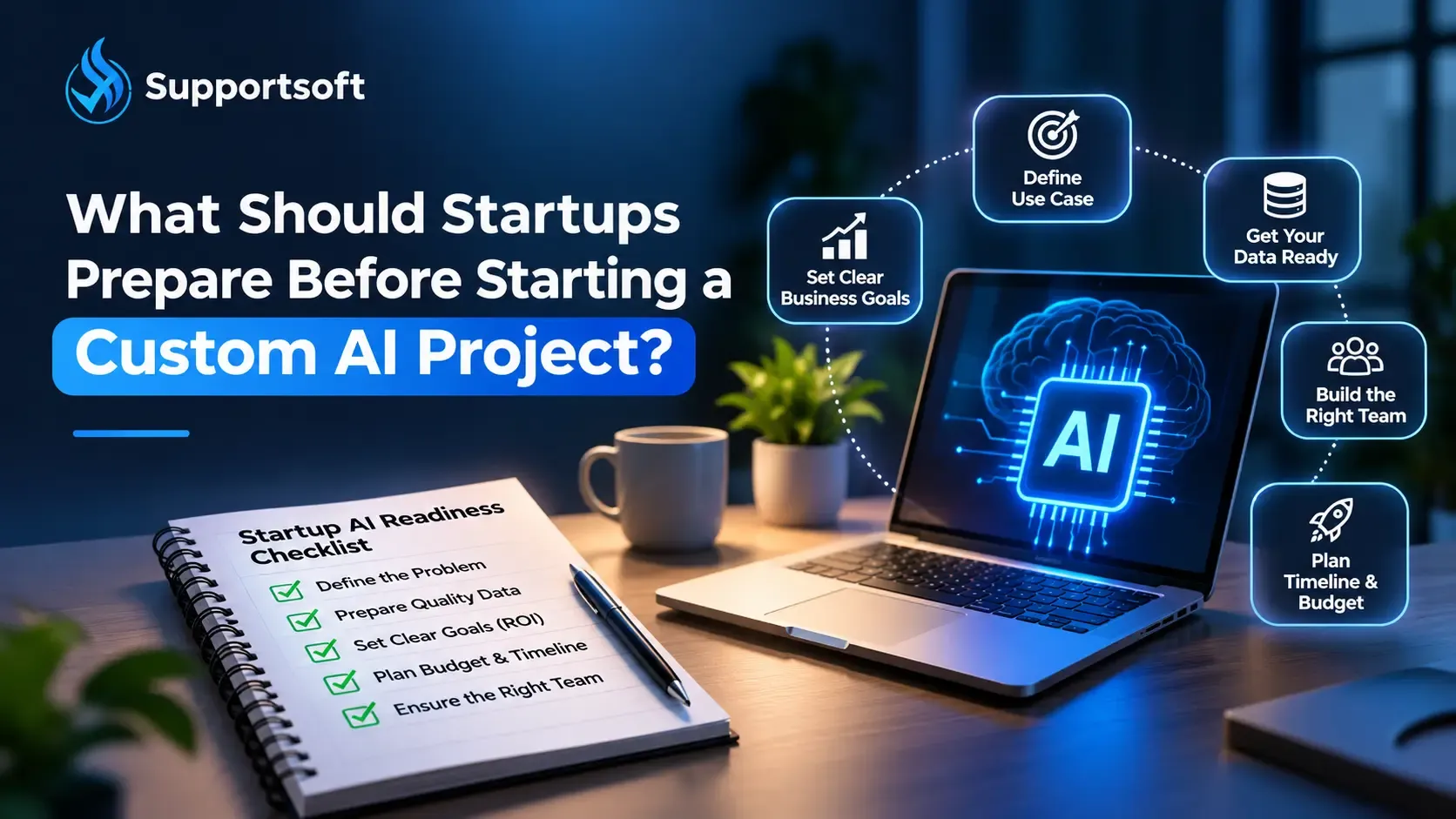
What Should Startups Prepare Before Starting a Custom AI Project?

Supportsoft Nov 19, 2026
AI is becoming part of many digital products, from customer support tools and recommendation systems to workflow automation and predictive analytics. For startups, these technologies can create opportunities to improve operations and develop new product capabilities. However, a successful AI project involves more than selecting a model or adding an AI feature. It requires a clear business objective, suitable data, realistic technical requirements and a plan for ongoing evaluation.
Introduction
Starting a custom AI project can be an important step for a startup looking to solve a business problem, improve an existing process or introduce a new digital product. AI can help automate repetitive tasks, analyse information, generate content and support decisions. However, adopting it without sufficient preparation can lead to unnecessary costs, technical difficulties and solutions that do not deliver meaningful business value.
One common mistake is beginning with the technology rather than the problem. A startup might decide that it needs a chatbot, recommendation engine or predictive model before establishing what the solution should achieve. In some cases, a simpler software feature of process improvement may be more appropriate.
Before investing in development, founders should understand the problem, define the project requirements, assess available data and consider how the solution will work with existing systems.
This guide explains what to prepare before starting an AI project, helping startups make informed decisions and establish a practical foundation for development.
Why AI projects Need Proper Planning
AI Projects involve several connected decisions. These include selecting an appropriate approach, preparing data, designing the software architecture, integrating the solution and evaluating its performance.
Without a clear plan, a project can become difficult to manage. Requirements may change during development, data may prove unsuitable, or the chosen technology may not address the original business problem.
Planning helps startups:
- Establish what the AI solution is expected to accomplish.
- Identify whether AI is necessary for the problem.
- Understand the data and infrastructure requirements.
- Estimate development complexity and operational needs.
- Identify privacy, security and reliability risks.
- Define how the solution's performance will be evaluated.
For example, a startup may want to reduce the time employees spend answering common customer enquiries. An AI-powered support assistant could be one option. However, the team should first understand the types of enquiries received, where the relevant information is stored and which questions require human involvement.
This initial assessment helps determine whether AI is suitable and what the first version should include.
Planning does not mean every technical decision must be finalised before development begins. It means establishing enough clarity to make informed decisions and reduce avoidable uncertainty.
Identify the Business Problem AI Should Solve
The first step is to define the business problem rather than selecting an AI feature.
A useful AI project should address a specific need. It might reduce manual work, improve information retrieval, help users discover relevant products or identify patterns in business data.
Start by examining the current process and identifying where difficulties occur.
Describe the Existing Problem
Ask:
- Which business process needs improvement?
- Who experiences the problem?
- How frequently does it occur?
- What happens when the problem is not addressed?
- How is the process currently managed?
- What limitations exist in the current approach?
For example, a startup operating an online marketplace may find that customers struggle to locate relevant products. The underlying problem is not necessarily a lack of AI. It may be that product information is inconsistent or the existing search functionality does not understand user intent.
An AI-based recommendation or search feature may help, but the project should begin with a clear understanding of the user experience and available product information.
Determine Whether AI is Appropriate
Not every business problem requires artificial intelligence.
A traditional rule-based system may be sufficient when the task follows predictable conditions. AI may be more suitable when the solution needs to interpret natural language, recognise patterns, classify information or generate responses.
For instance:
- A fixed approval workflow may only require conventional automation.
- Categorising large volumes of unstructured customer messages may benefit from machine learning or language models.
- Extracting information from varied documents may require AI-assisted document processing.
The objective is to select technology that fits the problem, not to introduce AI simply because it is available.
Define Your AI Project Requirements
Once the problem is clear, translate it into practical project requirements. These describe what the solution should do, how users will interact with it and what constraints the development team must consider.
Well-defined AI project requirements help prevent misunderstandings and provide a reference point throughout development.
Define the Core Functionality
List the essential tasks the AI solution must perform.
For an AI-powered customer support assistant, requirements might include:
- Understanding common customer questions.
- Retrieving relevant information from approved sources.
- Providing responses based on available business content.
- Recognising when a question cannot be answered confidently.
- Escalating selected enquiries to a human team member.
- Recording interactions for quality review, where appropriate.
Keep the initial feature list focused. Trying to automate every business process in the first release can increase complexity and make testing more difficult.
Identify User Roles and Access Requirements
Consider who will use the solution and what information each user should be able to access.
A startup developing an internal AI assistant may need different permissions for employees, managers and administrators. A customer-facing tool may require additional controls to prevent users from accessing private business information.
Document Functional and Non-Functional Requirements
Functional requirements describe what the system should do. Non-functional requirements describe how it should perform and operate.
| Requirement type | Examples |
|---|---|
| Functional | Answer questions, classify documents, generate summaries |
| Performance | Response time, processing capacity, expected workload |
| Security | Authentication, access permissions, data protection |
| Reliability | Error handling, availability, recovery procedures |
| Usability | Clear interface, accessible workflows, understandable outputs |
| Maintainability | Logging, updates, documentation and monitoring |
Also identify constraints such as the platforms the solution must support, third-party services it needs to connect with and any relevant data-handling obligations.
Assess Your Available Business Data
Data is a central consideration in many AI projects. A solution that relies on business-specific information may not perform as expected if that information is incomplete, outdated, inconsistent or difficult to access.
Before development begins, review what data your startup has and whether it is suitable for the intended use.
Identify Relevant Data Sources
Depending on the project, useful information may be stored in:
- Customer relationship management systems.
- Sales and transaction databases.
- Product catalogues.
- Customer support records.
- Internal documents and knowledge bases.
- Website analytics platforms.
- Operational software and business applications.
Create an inventory of the information that may be required. Identify where it is stored, who owns it and how it can be accessed.
Review Data Quality
Having a large quantity of information does not automatically make it useful.
Check whether the data is:
- Accurate and up to date.
- Consistent across different systems.
- Relevant to the intended business problem.
- Available in a format that can be processed.
- Free from unnecessary duplication.
- Collected and managed with appropriate permissions.
For example, an AI system designed to classify customer enquiries may struggle if historical support records contain inconsistent categories or incomplete descriptions.
Data preparation may therefore involve cleaning records, standardising formats, removing duplicates and reviewing missing information.
Consider Privacy and Data Permissions
Startups should understand whether they have the right to use particular information for the intended AI application.
Customer records, employee information and other sensitive data require careful handling. Consider what information needs to be processed, where it will be stored, who can access it and whether third-party AI providers will receive it.
For Australian businesses, privacy planning should take account of applicable obligations, including the Australian Privacy Principles where the Privacy Act 1988 applies.
Avoid including sensitive information in AI tools or external services without first understanding their data-handling arrangements.
Consider Integration with Existing Software
A custom AI solution rarely operates in isolation. It may need to communicate with the startup's website, mobile application, CRM, payment platform, internal database or other business software.
Integration should be considered during the planning stage because it can influence architecture, development effort and ongoing maintenance.
Map the Systems Involved
Identify which applications will send information to the AI solution and which systems will receive its outputs.
For example, an AI-powered support assistant may need to:
- Receive a customer question through a website.
- Retrieve relevant information from an approved knowledge base.
- Generate or prepare a response.
- Display the response to the customer.
- Transfer the conversation to a support platform when necessary.
Mapping this workflow helps clarify the integration requirements and identify dependencies.
Review API Availability
Application Programming Interfaces (APIs) allow different software systems to exchange information.
Before development, check whether the existing platforms provide APIs and whether those APIs support the required operations.
Important questions include:
- Can the required information be accessed securely?
- Are API permissions and authentication available?
- Are there usage limits or additional costs?
- How will integration errors be handled?
- How frequently does information need to be synchronised?
Some platforms may require custom integration work or alternative data-access arrangements.
Plan the Technical Implementation
The development approach should account for the AI component, backend services, data storage, user interface and external integrations.
For startups evaluating Custom AI Development Solutions in Australia, this is an important stage for discussing the proposed architecture, integration requirements, data handling and development priorities before implementation begins.
A clear technical plan helps ensure the AI feature fits into the wider product rather than becoming a disconnected tool.
Understand AI Costs, Risks and Limitations
An AI project involves more than the initial development budget. Startups should consider the costs and risks associated with building, deploying and maintaining the solution.
Understand the Main Cost Areas
Project costs vary according to functionality, data requirements, technical complexity and the selected infrastructure.
Potential cost areas include:
- Requirements analysis and solution design.
- Data collection, cleaning and preparation.
- AI model selection or development.
- Backend and frontend implementation.
- Third-party API or model usage.
- Cloud hosting and infrastructure.
- Testing and security reviews.
- Monitoring, updates and ongoing maintenance.
Some AI services charge according to usage, such as the number of requests, tokens processed or amount of data handled. These expenses may increase as the product gains users.
Startups should therefore estimate both initial development costs and recurring operational expenses.
Recognise Technical Limitations
AI systems do not always produce accurate or predictable outputs.
Depending on the application, limitations may include:
- Incorrect or misleading generated responses.
- Inconsistent results for similar inputs.
- Poor performance on unfamiliar information.
- Bias arising from training or reference data.
- Difficulty explaining certain model outputs.
- Dependence on external services or providers.
For generative AI applications, a system may produce plausible-sounding information that is incorrect. This is why validation, appropriate safeguards and human oversight can be important.
Plan for Security and Responsible Use
Consider how the system will protect information and prevent unauthorised access.
Relevant measures may include access controls, encryption, secure API authentication, logging, data retention policies and restrictions on the information users can submit.
The level of control should reflect the sensitivity of the data and the consequences of an incorrect output.
Set Realistic Goals and Success Measures
Before development starts, decide how you will determine whether the AI solution is delivering value.
Without defined success measures, it can be difficult to distinguish genuine improvements from assumptions or user enthusiasm.
Connect Technical Performance With Business Outcomes
Technical accuracy is important, but it should not be the only measure of success.
For example, a customer support assistant may be evaluated using:
- The percentage of enquiries resolved without human intervention.
- The accuracy and relevance of responses.
- The number of conversations escalated to staff.
- Average response time.
- Customer satisfaction.
- The amount of staff time saved.
A document-processing tool may be assessed by extraction accuracy, processing time and the number of records requiring manual correction.
Choose measures that reflect the original business problem.
Establish a Baseline
Where possible, record how the process performs before introducing AI.
If a startup wants to reduce the time employees spend categorising enquiries, it should first understand how much time the current process takes and how frequently errors occur.
A baseline provides a useful comparison when evaluating the new solution.
Define Acceptable Performance
Not every AI system needs to operate with perfect accuracy. However, the acceptable level of performance depends on the use case.
A recommendation feature may tolerate some irrelevant suggestions. An AI tool supporting financial, legal or other high-impact decisions requires a much more cautious approach, including appropriate human review and safeguards.
Set measurable acceptance criteria before development and testing.
Prepare for Testing and Ongoing Improvements
An AI solution should be tested against realistic scenarios before it is relied upon in a live business environment.
Testing should examine both whether the software works correctly and whether the AI component produces useful, appropriate outputs.
Prepare Representative Test Data
Create test examples that reflect the situations the system is expected to handle.
Include ordinary use cases as well as unusual inputs, incomplete information and edge cases.
For a customer-facing AI assistant, this might include:
- Frequently asked questions.
- Questions with ambiguous wording.
- Requests outside the assistant's intended scope.
- Questions involving outdated information.
- Attempts to access restricted information.
- Situations requiring human support.
Testing should also consider how the system responds when an external API or data source is unavailable.
Include Human Review Where Appropriate
Human oversight can help identify incorrect outputs, assess quality and manage situations that require judgement.
For example, an AI system may prepare a response for a customer support employee to review rather than sending every response automatically.
The appropriate level of oversight depends on the application's purpose and the potential consequences of errors.
Plan for Monitoring and Updates
AI performance can change as business information, user behaviour, models and external services evolve.
After launch, establish a process for:
- Reviewing output quality.
- Monitoring errors and unusual behaviour.
- Updating reference information.
- Checking integration performance.
- Managing model or service changes.
- Collecting user feedback.
- Reviewing usage and operating costs.
Ongoing evaluation helps the startup identify when the solution needs adjustment or additional development.
Common Mistakes Startups Should Avoid Before Starting an AI Project
Even a promising idea can become difficult to deliver if important preparation is overlooked.
Common mistakes include:
- Starting with a technology instead of a business problem: Selecting a chatbot or machine learning model before defining the need can result in an unnecessary solution.
- Underestimating data preparation: Existing business information may require substantial cleaning, restructuring or validation.
- Trying to build too many features at once: An overly broad first release increases development complexity and makes success harder to measure.
- Ignoring integration requirements: The AI component may not work effectively if it cannot access the systems and information it needs.
- Overlooking ongoing costs: Model usage, hosting, monitoring and maintenance can create recurring expenses.
- Expecting completely accurate outputs: AI systems require evaluation, safeguards and appropriate human involvement.
- Skipping post-launch planning: A solution needs monitoring and updates to remain useful as business requirements change.
A focused initial project, supported by clear requirements and realistic expectations, gives startups a more manageable starting point.
Conclusion
Starting a custom AI project requires more than an idea and a choice of technology. Startups need to understand the business problem, define realistic requirements, assess their data and plan how the solution will fit into existing systems.
They should also consider development and operating costs, recognise AI's limitations and establish measurable success criteria. Testing, monitoring and ongoing improvements should be included in the project plan from the beginning.
A focused approach helps startups avoid unnecessary complexity and make better-informed investment decisions. By preparing these elements before development starts, businesses can create a clearer path from an initial AI idea to a practical solution that supports their objectives.
Frequently Asked Questions
What should a startup prepare before starting an AI project?
A startup should define the business problem, establish project objectives, document functional requirements, assess available data, identify integration needs and understand potential costs and risks. It should also decide how the solution will be tested and evaluated.
Does a startup need large amounts of data to build an AI solution?
Not necessarily. The amount and type of data required depend on the application. Some solutions can use existing foundation models with carefully prepared business information, while others may require larger, specialised datasets. Data quality and relevance are often as important as quantity.
How do you know whether a business problem needs AI?
Consider whether the problem involves tasks such as interpreting language, recognising patterns, classifying information or generating context-sensitive outputs. If the task follows simple, predictable rules, conventional automation may be more suitable.
What are the main requirements for a custom AI solution?
Requirements typically include the intended functionality, user roles, data sources, integration needs, performance expectations, security controls and maintenance arrangements. The exact requirements depend on the business problem and the proposed application.
How much does it cost to start an AI project?
There is no single cost for an AI project. The budget depends on the complexity of the application, data preparation, model or service selection, integrations, infrastructure, testing and ongoing usage. A clearly defined initial scope makes cost estimation more practical.
Should startups build their own AI model?
Not always. Depending on the use case, a startup may be able to use an existing AI model through an API, connect a model to its own business information or fine-tune an existing model. Developing a model from scratch is generally a more specialised undertaking and should be justified by the requirements.
How long does it take to develop a custom AI solution?
Timelines vary according to the project's scope, data readiness, integration complexity and testing requirements. A focused proof of concept may take considerably less time than a production-ready application with multiple integrations and operational safeguards.
Why is AI testing important before launch?
Testing helps determine whether the solution produces useful outputs, handles unexpected inputs and works reliably with connected systems. It can also reveal security, privacy and performance issues before the application is made available to users.